Choose direct embroidery when you want the design stitched into the garment without a separate badge. Choose a patch when a defined badge shape, repeatable emblem or removable attachment is part of the brief. Then choose the patch construction and attachment separately: an embroidered patch, a woven patch and a sticker-backed emblem are not interchangeable products.
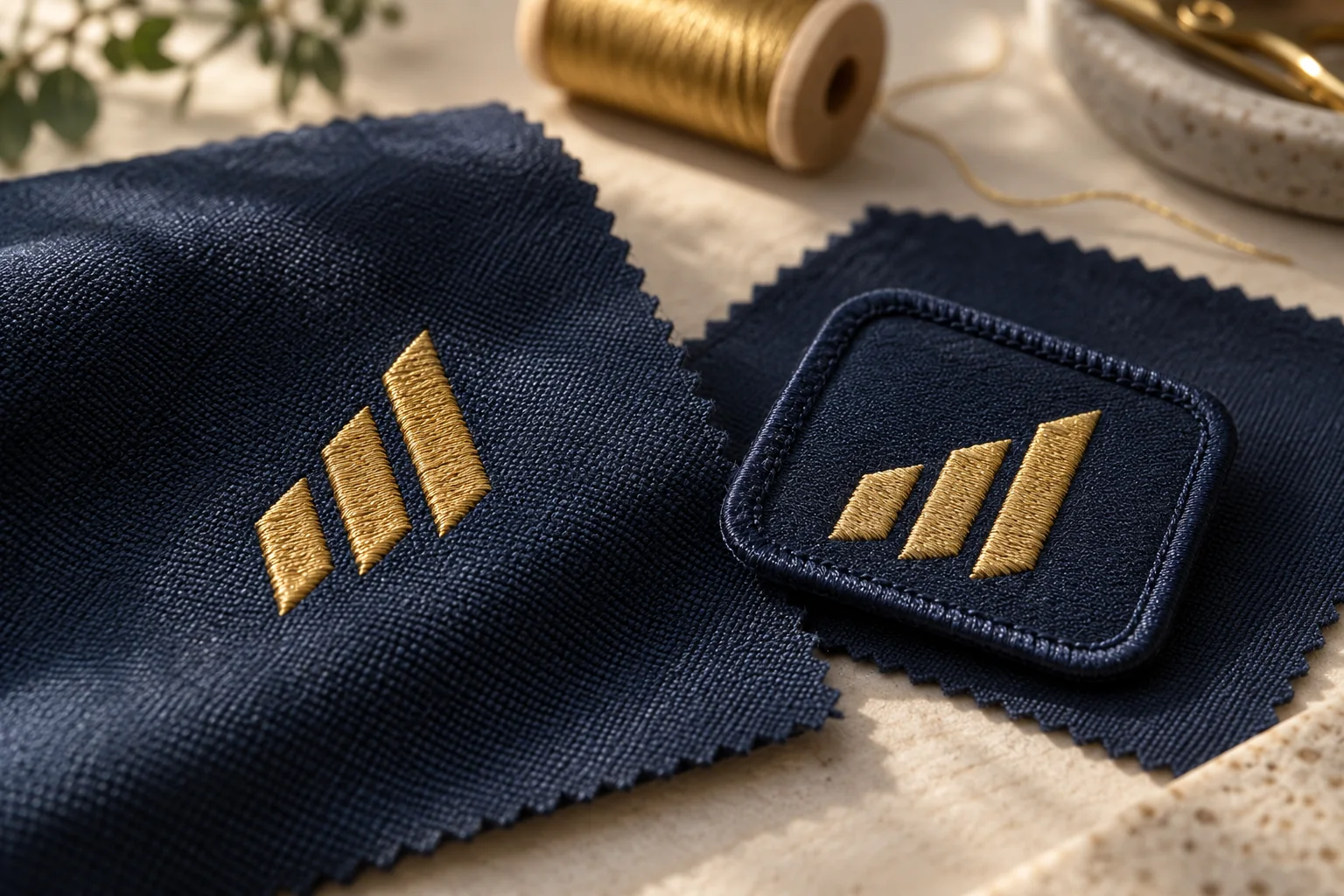
The useful buying question is not which method looks more premium in a photograph. It is which complete combination—artwork, garment, location, attachment and replenishment plan—works for the people wearing it. A patch that looks excellent loose on a desk has not yet passed as a decorated shirt.
Publisher perspective: Brand Sauce publishes this guide from a company-merchandise buying perspective. The framework below is our editorial recommendation, not a promise that every decoration method is available through every Brand Sauce program. Confirm the exact garment, destination, decoration and price in a written quote. Primary sources checked October 6, 2026. The hero is AI-generated conceptual artwork, not a supplier sample.
Separate the three decisions hidden inside “a patch”
Construction describes how the visible design is made. Direct embroidery puts stitches into the item itself. A patch is a separate component attached afterward; its face might be embroidered, woven or made using another process. A buyer asking for an “embroidered logo” should specify whether a separate badge is acceptable.
Attachment describes how that component stays on the item. Options may include sewing, a heat-applied backing or a hook-and-loop system. Pressure-sensitive adhesive is another category, but a sticker backing is not automatically a washable apparel attachment. Ask for the exact backing name rather than approving the generic word “adhesive.”
Program structure describes when each part is purchased. You might order finished garments in one batch, decorate individual garments as orders arrive, or pre-buy patches and apply them later. That third route delays garment commitment but still creates inventory. The component can become obsolete even if no shirt has been decorated.
Use this selection matrix before requesting samples
| Your main requirement | Start by evaluating | What must pass before approval |
|---|---|---|
| A restrained chest logo without a badge outline | Direct embroidery | Legibility, fabric behavior and comfort on the exact garment |
| A deliberate badge shape on caps or heavier apparel | An embroidered patch | Overall size, edge finish and attachment on the actual location |
| Dense artwork or small lettering inside a badge | A woven patch alongside a simplified embroidery version | Readable production artwork at final size, not just an enlarged proof |
| A badge that employees can intentionally change | A designed hook-and-loop arrangement | Both mating parts, attachment to the garment and an acceptable appearance without the badge |
| A small, unpredictable flow of individual orders | Verified per-order decoration, or a carefully sized component reserve | Minimums, ownership of unused components and replenishment lead time |
| A fixed event quantity with a stable design | A quoted batch of complete decorated items | Delivered cost, size allocation and a realistic production schedule |
These are starting points, not compatibility guarantees. If neither construction passes on the chosen fabric, change the design, placement or garment. Do not force a badge onto an unsuitable product just to keep every item in the store visually identical.
Small text is an artwork problem before it is a patch decision
Review the design at the dimensions someone will actually wear. A department name that is crisp on a monitor may be unreadable at chest-logo size. Ask the decorator to show the smallest lettering, narrow gaps and border thickness at final scale. Give the brand owner two honest options: preserve all the wording in a larger design, or approve a simplified small-format version.
STAHLS’ woven-patch documentation identifies its interlaced construction as suitable for small lettering and intricate detail. That makes woven patches worth sampling for a dense badge, but does not prove that every detailed logo will reproduce successfully. The same page currently lists a 50-piece minimum and says its preproduction approval is an electronic simulation, with no preproduction physical sample available for that product.
Direct embroidery should not be dismissed automatically. Madeira’s embroidery-thread guide describes finer thread options for small lettering and detail, including different digitizing and needle recommendations. The buyer’s takeaway is to ask whether a specialist setup can meet the brief, not to impose a universal minimum letter height from a different thread or garment.
Request a production-size rendering for both alternatives. If the logo includes a tagline that cannot be reproduced clearly, an authorized logo-only version can be a better decision than a larger, heavier badge. For the broader method choice, see our embroidery-versus-printing guide.
Treat attachment as a separate approval gate
A patch face and its attachment can succeed or fail independently. Your purchase order should identify the backing, application process, approved garment and placement. “Heat applied” is incomplete if the supplier has not established that the chosen fabric and finished garment tolerate the process.
For a concrete distinction, STAHLS’ embroidered-patch instructions list cotton, polyester and cotton/poly blends for its heat-applied version, while specifying smooth hard goods for its pressure-sensitive version. The page also gives different application instructions for different presses. These are product-specific directions, not permission to use any patch on any polyester item.
For sewn patches, request a sample that shows the attachment stitching and the inside of the garment. For a removable system, specify both the patch-side and garment-side components. A hook-backed patch alone is not a complete clothing solution. Confirm who supplies and attaches the mating surface, and whether it remains acceptable when no patch is fitted.
Pay particular attention to pockets, seams and curved cap fronts. Ask the decorator to show the finished result at the proposed location and demonstrate that the pocket remains usable. A flat loose sample cannot settle those questions. Avoid treating a patch as an automatic way to preserve a garment’s waterproof or protective performance; the relevant garment manufacturer must approve the complete decoration approach.
Approve the worn item, including the inside
Evaluate the sample as clothing, not only as a logo holder. Try it on, move normally and inspect the reverse side. Record whether the decoration feels stiff, rubs, pulls the fabric or creates an awkward edge. Compare equivalent placements rather than declaring one method more comfortable from two different garments.
Write a single usable care instruction for the finished item. The garment label, thread, patch material and adhesive may impose different limits. If their requirements cannot be reconciled, the combination is not ready for the program. A supplier’s domestic-washing claim should not be treated as evidence for industrial laundering.
Have the provider propose a relevant care trial and document the result against an agreed acceptance standard. Photograph the same area before and afterward, including edges and reverse-side attachment. This is a buyer acceptance check, not a certification or a prediction of years of service. Do not invent a wash-life guarantee from a short sample trial.
If the product does not offer a preproduction physical sample, disclose that before collecting approval. Consider a comparable construction sample for feel, a final-size digital proof for artwork, and a limited first production run where available. Those steps reduce different uncertainties; they do not magically become a physical sample of the exact final design.
Compare complete costs and account for unused patches
Request comparable quotes for the same garment, design dimensions, destination and order pattern. Include artwork preparation, digitizing where applicable, patch manufacture, attachment, samples, garment handling, freight and any storage or retrieval charges. Use “quote needed” for unknowns. A loose-patch unit price is not a finished-garment price.
Ask separately about the minimum for making patches and the minimum for applying them. A provider may accept one finished garment order while requiring a batch of custom components upfront. For ongoing stores, record the component owner, inventory visibility, reorder point, storage conditions and what happens when the logo changes. Our guide to no-minimum branded merchandise explains why the exact product and decoration combination matters.
Illustrative calculation, not a supplier quote or measured result: suppose 100 patches cost $3 each, and attachment costs $2 per garment. If 60 garments are decorated before a rebrand, patch purchase plus application totals $300 + $120 = $420, or $7 per decorated garment, excluding garments and every other cost. Forty old-design patches remain.
If all 100 are eventually applied, those same assumed costs total $500, or $5 per garment. The difference comes from usage, not a change in patch quality. If the remaining forty become unusable, do not add their purchase cost a second time to the first calculation—it is already included in the $300. Compare either scenario with a real complete-decoration quote before deciding.
Bulk can be the sensible choice for a known event quantity, especially when the design and size split are settled. Per-order production can reduce commitment when demand is uncertain. A hybrid component reserve can support later orders, but only if someone manages it. None of these models automatically has the lowest landed cost.
A hypothetical two-product decision
Imagine a company wants one identity across staff polos and event caps. Its full badge contains a symbol, company name and small regional wording. The team initially asks for the same embroidered patch on both products.
A better brief separates the common identity from the physical construction. The polo can be evaluated with a simplified directly embroidered company mark; the cap can be evaluated with a woven regional badge. Both proposals go to the brand owner at final size. Matching artwork rules does not require an identical raised rectangle on every surface.
Before choosing, the buyer requests an applied polo sample, confirms the cap’s patch-proof limitations, and gets two complete quotes. It also asks whether regional variants each have their own minimum. A total headcount of 120 does not resolve the economics if there are six separate designs and only twenty expected wearers of each.
This is a decision example, not a Brand Sauce client story or a claim about available products. Its lesson is to group demand by the component that actually carries the minimum, rather than by the size of the organization.
Keep one approval record for every garment-and-decoration pair
- Item: exact garment style, color, size range and destination program.
- Artwork: approved version, physical dimensions, thread or material colors, and any simplified text.
- Construction: direct embroidery or the exact patch product and edge finish.
- Attachment: backing, application owner, location and required mating component, if any.
- Evidence: digital proof, physical sample or stated sample limitation; photos of front and inside; care-check findings.
- Commercial terms: minimum per design, complete price, replenishment timing and unused-component ownership.
- Decision: approver, date, unresolved exceptions and changes requiring a new review.
A substitute garment, different backing or changed logo size should trigger a review of the affected approval—not a silent substitution. Use our apparel-sample approval guide for the broader release process. Keep the record accessible to whoever handles later orders so a successful first batch can be reproduced intentionally.
Frequently asked questions
Are patches always more durable than direct embroidery?
No universal winner follows from the method name. The garment, thread or patch construction, attachment, use and care all matter. Compare finished-item evidence for your actual conditions rather than an unsupported lifespan claim.
Can an employee remove a patch and put it on another garment?
Only plan for that when the attachment system is designed and approved for removal and reuse. A sewn or heat-applied patch is not automatically transferable without marks or damage. A removable badge still needs a compatible receiving surface.
Can we use one patch across every store product?
You can investigate it, but approve each garment-and-placement combination. A design that suits a cap may be too large or stiff for a polo. Shared artwork is a brand decision; shared physical construction is a separate production decision.
What should we send with a quote request?
Send the approved artwork, intended dimensions, exact items, placements, quantities by design, reorder pattern, destination and care expectations. Ask for the construction and backing to be named explicitly, with sample availability and all unknown prices marked for confirmation.