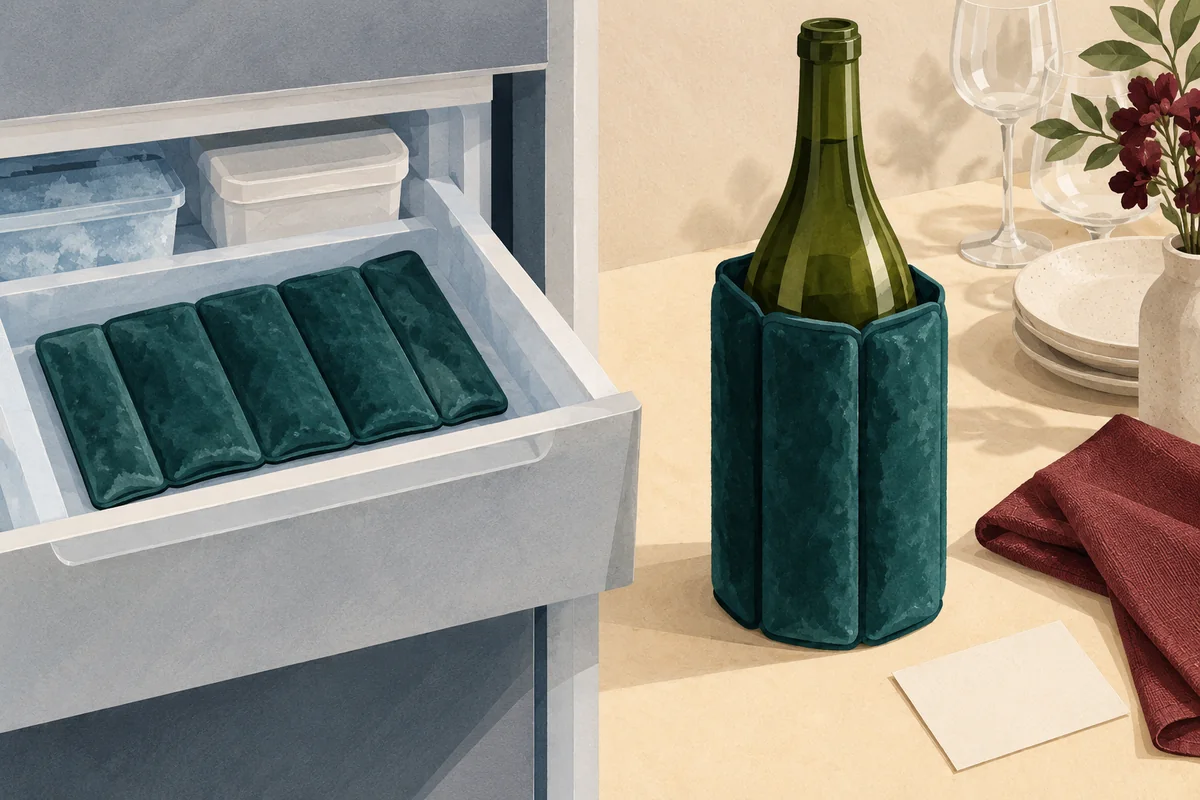
A reusable wine-cooler sleeve may need hours in a freezer before it can chill a bottle. “No ice required” does not necessarily mean “ready straight from the gift box.” Before choosing sleeves for a holiday host gift or hospitality-team thank-you, establish whether the product adds cooling through a frozen element or simply helps an already-cold bottle stay cold.
The useful buying question is not just “How long does it keep wine cool?” It is “Who prepares it, where, and before which occasion?” A good take-home gift can be a poor same-evening table accessory if nobody has prepared the cooling elements.
Read the preparation instruction before the cooling claim
Vacu Vin’s own cooling guide distinguishes its gel-filled active coolers from ordinary insulating coolers. It instructs users to freeze the cooling element for at least six hours, recommends pre-chilling the wine, and advises matching the cooler model to the bottle. That six-hour instruction is for these products, not a universal rule for every wine sleeve.
By contrast, a sleeve that only insulates is not a substitute for initially chilling the bottle. Ask the supplier to identify the cooling mechanism explicitly: frozen gel, another removable element, insulation alone, or a different design with its own instructions. Do not assume every sleeve can go in a freezer.
Do not turn a manufacturer’s advertised cooling time into your event’s serving promise. Starting bottle temperature, the intended serving temperature and the actual setup need to be specified before a sample check means anything.
Bottle volume is only the beginning of the fit check
The Le Creuset US Wine Cooler Sleeve listing describes interior gel, elastic sides and a tapered top, with a stated fit for all 750 ml bottles. That is the manufacturer’s fit claim, not a Brand Sauce test. Its page also specifies hand washing. Confirm the instructions supplied with the exact SKU rather than borrowing another brand’s freezing or care directions.
For a planned bottle-and-sleeve pairing, approve the actual bottle shape: body width, shoulder and how far the sleeve reaches. If recipients will use their own bottles, describe the supported size and shape rather than saying “fits anything.” The same approach applies to nonalcoholic bottled drinks; verify the bottle rather than assuming the label category determines fit.
These manufacturer examples explain what to check; they are not a verified Brand Sauce catalog shortlist. The US Le Creuset page displays both in-stock and out-of-stock interface text, so it does not establish available order quantity. For either brand, decorated supply, destination-country availability, delivery and pricing remain quote-needed.
A five-line approval card
Copy this into the product request and leave unknown fields visibly unresolved:
- Use: take-home gift for later use, or prepared accessory for a specific service time?
- Preparation: exact model; manufacturer instruction link; what goes in the freezer, for how long, and who is responsible?
- Fit: named bottle or supported dimensions; sample checked with the sleeve in its instructed ready-to-use condition?
- Release condition: starting drink temperature, intended serving temperature, room conditions and the time at which someone will check it?
- Handoff: model-specific preparation and cleaning card included; recipient can read it without scanning a code; alternative gift available?
If the preparation owner or freezer access is missing, approve the item only as a take-home gift for later use—not as the event’s cooling equipment. If fit is unresolved, hold the bottle-and-sleeve bundle until a sample is checked. If the gift itself is unwanted, use a decline or alternative-selection option rather than treating a wine accessory as universal.
Worked example: the afternoon handoff problem
Illustrative planning scenario, not a customer result: a hotel team receives boxed sleeves at 3 p.m. for a 6 p.m. appreciation dinner. The selected model’s instructions require at least six hours of freezing. The three-hour gap cannot satisfy that instruction, even before allowing for unpacking and placement in the freezer.
The buyer has two straightforward choices: arrange preparation early enough with the venue, or distribute the boxed sleeves as take-home gifts and leave dinner beverage service to the venue’s existing equipment. Do not solve a preparation gap by removing the instruction card or promising instant cooling.
For a broader choice-based thank-you, use an employee gift preference survey to find out whether home entertaining accessories belong in the selection at all. The final approval should cover both the object and the small task it asks its recipient to do.
Illustration: AI-generated editorial artwork, not a product photograph or cooling-test result. Manufacturer pages reviewed October 30, 2026.