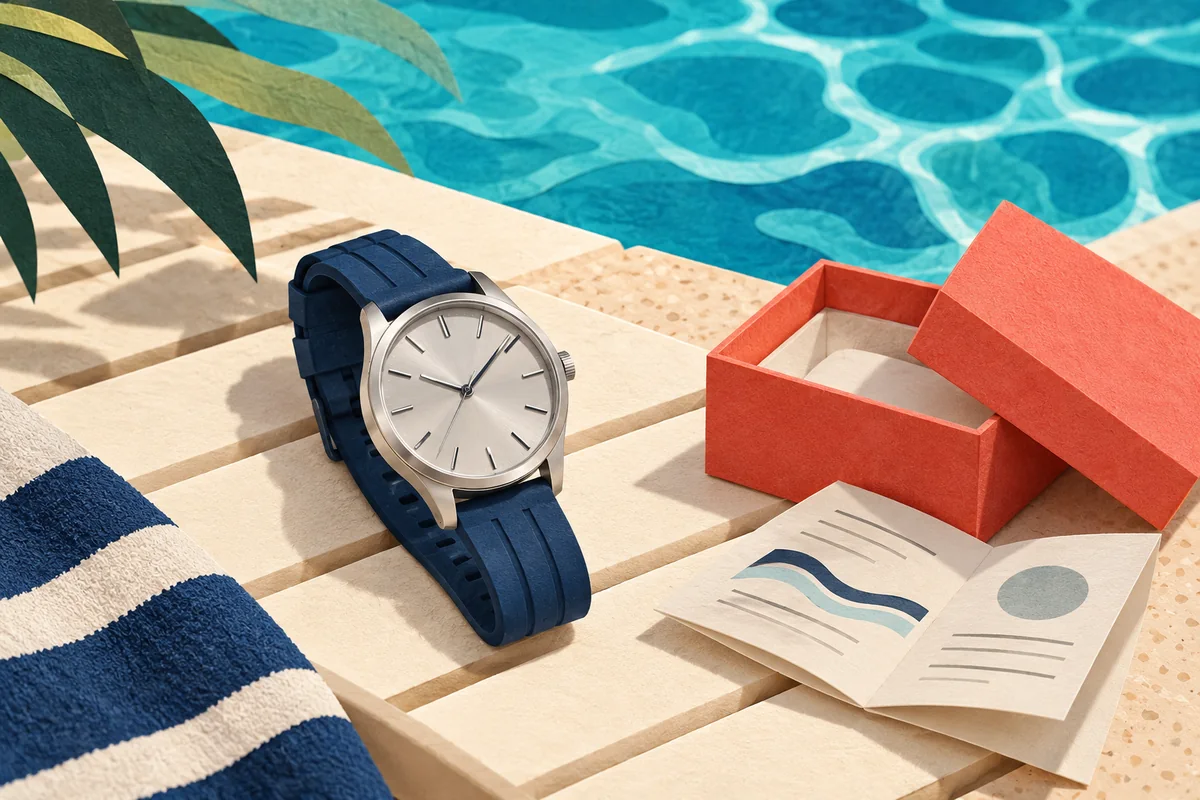
A 50 m water-resistance rating can allow swimming, but buy against the watch maker’s permitted activities—not an assumed swimming depth. For a recognition gift, the useful question is “Can the recipient wear this particular watch in the pool?” rather than “Which watch has the biggest number?”
A hotel team choosing anniversary gifts may want a watch that works off duty as well as at reception. A dress watch for everyday wear and a watch intended for pool use can both be good gifts. The mistake is presenting them as interchangeable because both listings mention water resistance.
What “50 m” actually tells the buyer
Timex’s water-resistance guide lists light swimming among the activities allowed for its 50 m category, while its 30 m category lists hand washing. It also says that watches marked water-resistant without a depth should not be submerged. That is useful screening guidance, not permission to describe every 50 m watch as a dive watch.
Casio’s U.S. support guide similarly permits swimming for its 50M category but excludes snorkeling and scuba diving. Its ordinary 200M category still excludes scuba; the guide distinguishes that from watches specifically marked DIVER’S WATCH 200M. Timex’s general chart describes recreational scuba differently at 200 m. Do not combine two manufacturers’ charts into one universal buying rule. Get the instructions for the exact model being offered.
These manufacturer guides were checked November 1, 2026. They explain ratings; they are not a verified Brand Sauce watch assortment. Availability by recipient country, corporate-order quantities, decoration options and delivered prices remain quote-needed.
Use this three-way selection rule
- Everyday gift, no swimming promise: approve the appearance, fit and everyday care instructions. Describe the watch using its documented rating without adding “pool-ready.”
- Gift explicitly intended for swimming: require the exact model’s manufacturer instructions to permit the intended swimming activity. Confirm the supplied strap is appropriate for that use too. A rating alone does not settle the whole gift specification.
- Snorkeling, diving or a specific water sport: treat this as a separate requirement. Do not upgrade an ordinary gift watch on the strength of a bigger printed number or a diver-style bezel. Request explicit activity approval for the model, or offer a different gift.
If recipients’ preferences are unknown, make pool use a selection filter rather than a promise attached to the entire watch category. Someone who prefers a dress watch should not have to choose a sportier design just to participate.
The care card matters as much as the box
Casio says not to operate ordinary water-resistant watches’ buttons or crown while wet or submerged, with a stated exception for its DIVER’S WATCH 200M casing models. It also advises against baths and detergent exposure, and calls for a fresh-water rinse after seawater use. A swimming allowance is therefore not a blanket shower, soap or underwater-button allowance.
Keep the manufacturer’s care instructions with the gift. If you add a branded card, link to the exact manual instead of compressing all the restrictions into “waterproof.” For a personalized watch, ask the supplier whether the proposed decoration changes the documented care or warranty conditions; do not assume an undecorated sample settles that question.
Copy this watch approval card into the quote request
- Identity: manufacturer, exact model/reference, supplied strap and destination country.
- Intended use: everyday wear only, light pool swimming, or a specifically named activity.
- Evidence: model manual URL and the passage permitting that activity. If only a general chart is supplied, request model confirmation before making the claim.
- Controls and care: crown position, whether buttons may be used wet, cleaning instructions and any activity exclusions.
- Personalization: approved method and location, plus written confirmation of any effect on care or warranty.
- Handoff: manual included, recipient-facing description checked, and named support route for service or battery replacement.
- Decision: approve for the stated use, offer as everyday-only, or hold until the missing evidence arrives.
This is a document-and-sample review, not an instruction to dunk a gift sample and declare it certified. Check the actual delivered model against the approved reference; a visually similar substitution must pass the same requirements.
A practical approval example
Illustrative scenario, not a customer result: a hotel’s anniversary selection includes two watches. Option A has a 50 m marking and model instructions permitting light swimming. Option B says only “water-resistant,” and its supplier has not provided activity guidance. The team can label A for the documented swimming use, subject to its instructions. It cannot give B the same description simply because B costs more. It can keep B as an everyday option with accurate care information, or hold it pending clarification.
Before launch, agree the recipient’s warranty and support route. If the approved watch becomes unavailable, apply the gift substitution review to the use requirement as well as the look and price. A replacement is not equivalent if it removes the reason the recipient selected it.
AI-generated editorial illustration; not a catalog photograph or a water-resistance test.