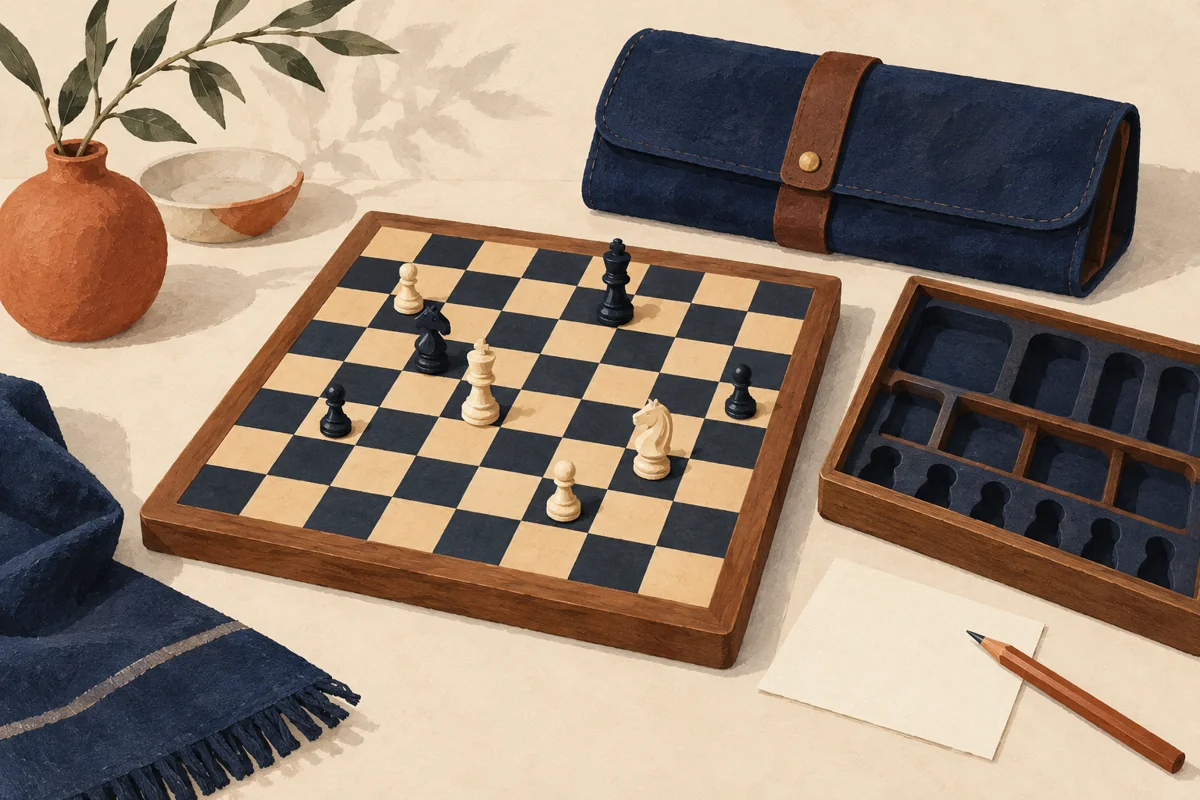
Not necessarily. Magnetic pieces can help a game stay put while you play; they do not, by themselves, mean you can close the board with the position intact. For a travel chess gift, ask whether the set packs away the pieces or preserves the unfinished game. Those are different features.
This matters for a coworking space offering member gifts or running lunchtime chess sessions. If everyone must clear the tables after a break, a beautiful folding set may still require players to record the position and rebuild it next time.
Look at the closure, not just the magnets
Two manufacturer listings make the distinction concrete. The House of Staunton 10-inch Folding Wooden Magnetic Travel Chess Set, TRV0020 describes foam inserts for storing the chessmen when not in use. That is evidence of piece storage—not a promise that an unfinished position survives closing the board.
By contrast, the 8-inch Ultimate Wooden Magnetic Travel Chess Set, TRV0028 explicitly describes a two-part closure designed to save the position for later. Its closing flaps are a model-specific feature. Do not transfer that claim to another set merely because both listings say “magnetic.”
These are manufacturer examples, not a Brand Sauce catalog shortlist or our product tests. At the October 31, 2026 check, the folding model was marked sold out and the Ultimate model in stock on the manufacturer’s site. Neither status establishes supply for your recipient countries, a corporate quantity or a decorated order. Country availability, branding feasibility and delivered pricing remain quote-needed.
Write the requirement as a task
Instead of specifying “premium magnetic travel chess,” choose the sentence that matches the gift’s purpose:
- Pack after a finished game: all pieces must fit in their intended storage positions and the case must close normally. Preserving the board position is unnecessary.
- Pause and carry an unfinished game: the exact model must support closing with pieces still on their squares, and a sample must demonstrate the intended carry-and-reopen routine.
- Pause on a shelf: decide whether the board can stay open in a protected location. A compact folding case is less important if nobody needs to pack it.
A smaller board is not automatically the better gift. Ask a prospective user to distinguish the pieces, reach the central squares and move a piece without disturbing its neighbors. If providing games across locations, also check the rules and language needs of the exact edition.
A close-and-resume acceptance card
Use this suggested buyer check before approving a position-preserving set. It is an acceptance exercise, not a durability certification, and we have not performed it on the examples above.
- Identify: record the model, supplier and written instruction allowing closure with an unfinished game. If that permission is missing, ask before attempting it.
- Set up: arrange a recognizable position with pieces near the center and edges, including the tallest pieces. Take a reference photo.
- Account for captures: identify where captured pieces go. They should not be loose where they can interfere with the closure or remaining position.
- Close: follow the instructions without forcing a flap or latch. Check that any proposed branded sleeve or packaging does not change the closure.
- Carry and reopen: use the normal intended hand-carry route, then compare every piece with the reference photo. Do not substitute a drop or shake test for ordinary use.
- Decide: record approved for pause-and-carry, approved for pack-away only, or rejected. Keep the model code, sample date and result together.
When recording a real game, also note whose turn it is and retain the move record if needed; a photo records the visible arrangement, not every detail of game history. The set should not be marketed as remembering those details for you.
If the right set is unavailable
Illustrative decision: a coworking operator wants members to continue games across lunch breaks, but the available gift set requires pieces to be removed before folding. The operator can choose a verified position-preserving model, provide a position-recording card with the ordinary set, or keep shared boards on a designated shelf. These solve different needs; they are not interchangeable simply because their boxes are similar sizes.
If a recipient has already chosen a pause-and-carry set, follow an explicit gift-substitution approval process before replacing it with a pack-away model. A change in how the gift works matters more than the word “travel” remaining on the label.
AI-generated editorial illustration; not a catalog product photograph or evidence of a completed test.