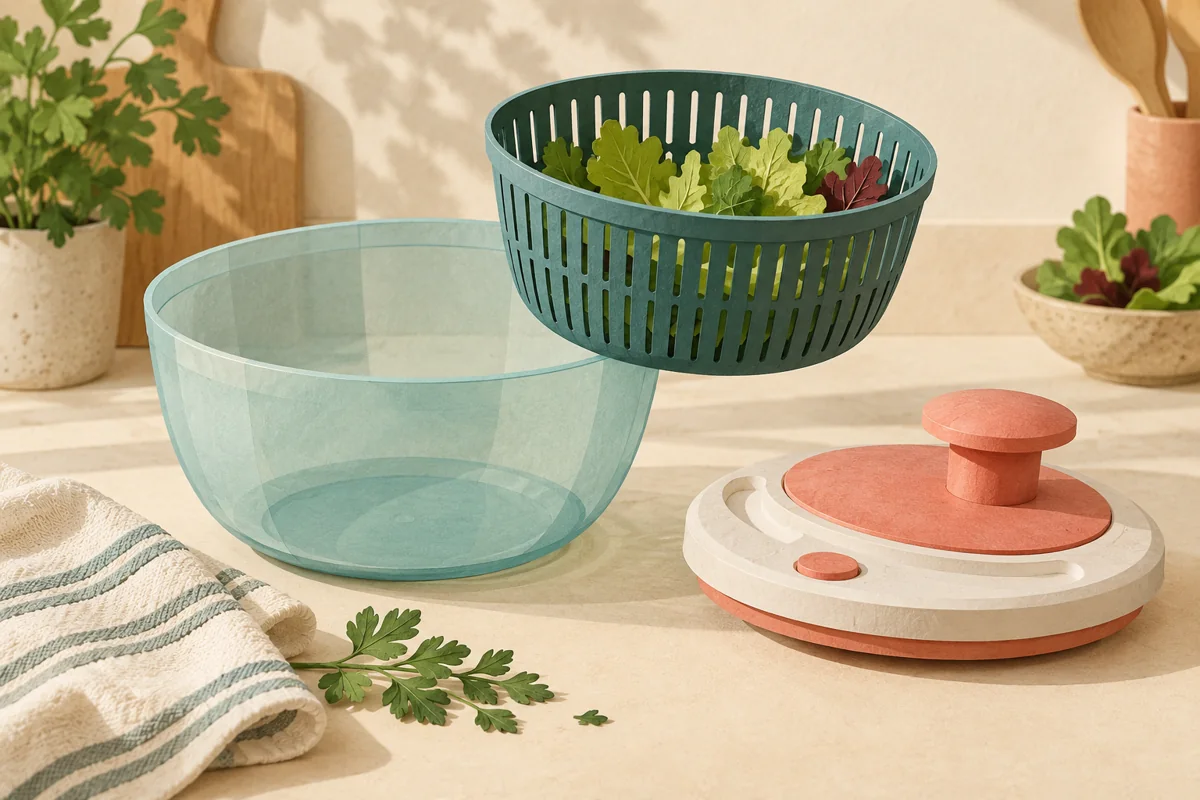
Choose a salad spinner by its removable basket capacity, not just the larger number printed for the outer bowl. The bowl catches water; the basket holds the greens. Neither volume tells you how many portions a recipient can dry comfortably in one batch.
For a cooking-themed employee gift menu, this is a useful question to settle before picking the larger-looking option. A generous spinner may suit batch preparation but be awkward to store. A compact one may suit herbs and small batches but require more rounds for a family meal. Make kitchen tools an optional choice rather than assuming every recipient wants one.
Why does one spinner have two capacities?
OXO's US listing for its white Salad Spinner, SKU 32480, specifies a 6.22-quart bowl and a 4.95-quart basket. Its US Little Salad and Herb Spinner, SKU 1045409, lists a 3.03-quart bowl and a 2.44-quart basket. Those are manufacturer specifications, not our measurements.
The distinction matters: a listing shortened to “6.22 quarts” would describe the outer bowl, not the space inside the spinning basket. OXO also describes removable colander baskets and lids that come apart for cleaning. That makes the parts worth checking separately, not treating the assembled spinner as one solid container.
These are US manufacturer examples explaining how to read specifications, not a verified Brand Sauce product shortlist. They do not establish decoration eligibility, bulk stock or delivery availability in another country. Obtain an exact-model, destination-specific quote before adding any spinner to a gift offer; branded pricing is quote-needed.
The basket–batch–cupboard selection card
Use this card for each proposed model. An unanswered item stays open; a larger advertised volume does not close it.
- Basket: Record the model/SKU, basket capacity and outer-bowl capacity in separate fields. If the supplier gives only one volume, ask which part it measures. Compare like units and the exact regional model.
- Batch: Define the task in ordinary terms: a handful of herbs, one lunch salad, or greens for a shared dinner. Ask the supplier to demonstrate a representative loose load within the manufacturer's instructions. Record whether it needs one batch or several. Do not convert quarts into promised servings: leaf size, packing and the user's portion all vary.
- Operation: On a sample, check whether the intended user can load it, start the mechanism, stop it and lift the basket without an awkward grip. Treat pump, cord and crank designs as different actions to try, not automatic accessibility ratings. Our accessible gift-selection guide explains why choice matters more than a universal “easy to use” label.
- Cleanup: Have the supplier show which lid pieces come apart and provide the exact care instructions. Confirm any decoration's care limits separately. A removable basket alone does not answer how to clean the mechanism.
- Cupboard: Record the assembled storage width and height, including the handle or pump in its storage position. Check the recipient's available shelf space if known. “Small” is not a shelf-fit specification.
Decision rule: shortlist the smallest model that handles the intended batch acceptably, can be operated and cleaned comfortably, and fits the available storage space. If storage or cooking habits are unknown, offer a non-kitchen alternative instead of buying the largest model for everyone.
Worked example: the bigger number loses
Illustrative scenario, not a product test or customer result: a team is planning an optional cooking gift for people who prepare individual lunches. Candidate A is advertised with a six-quart outer bowl, but its basket volume and stored height are missing. Candidate B supplies both capacities and fits the stated cupboard space; its sample still needs a representative-load check.
The buyer does not approve A because six is the largest number. They request its missing specifications and keep B conditional on the load, operation and cleanup checks. If B passes, its smaller size can be the better match for this brief. If recipients want large shared meals instead, the decision may reverse. The point is to test the intended task, not crown a universally best spinner.
Copy this into the supplier brief
Please quote the exact spinner model for [destination country] and [quantity]. State basket capacity and outer-bowl capacity separately, with units; assembled storage dimensions; operating mechanism; removable cleaning parts; and care instructions. Our intended task is [batch description]. Confirm sample availability, any decoration method and location, decoration-specific care limits, stock and delivery timing. Please do not substitute another size or regional version without approval.
Keep those requirements attached to the gift listing. If the approved model becomes unavailable, use a substitution approval process that checks basket size, storage footprint and operation—not just whether the replacement is also called a salad spinner.
Editorial illustration: AI-generated to explain nested bowl and basket construction; it does not depict a verified catalog item or a product test.