Approve a notebook-and-pen gift as a pair, with writing on both sides of a page. A paper-weight number and an attractive cover do not tell you whether the supplied pen leaves the reverse side comfortable to use—or whether fresh notes transfer when the book closes.
For a professional-development gift or a meeting notebook, the practical question is simple: can recipients take notes at their normal pace and use the pages you are counting? This guide covers ordinary paper notebooks, not wipe-clean reusable books or watercolor sketchbooks.
Do you need a higher GSM?
Not automatically. GSM expresses paper mass per square meter; it is not an ink-compatibility guarantee. Rhodia lists its Composition Book with 80 g paper and describes it as fountain-pen friendly. Its Rhodiactive hardcover notebook uses 90 g paper and carries a manufacturer claim that ink will not bleed or feather. Those are specifications for particular products, not evidence that every 80 or 90 gsm notebook performs alike.
These official examples, checked November 8, 2026, are not Brand Sauce catalog offers or results of our own tests. They show why a blanket “120 gsm minimum” requirement can exclude paper expressly intended for fountain pens without actually proving that the remaining candidates suit your gift pen. Ask for the exact notebook and writing-tool specifications, then review the combination.
Name the problem before rejecting the sample
Use four separate observations in your approval record. The distinctions matter because a clean-looking front page can still be unpleasant to use on the back:
- Feathering: the edges of a written line spread into fuzzy branches instead of staying crisp.
- Bleed-through: ink penetrates the sheet and marks its reverse side. Also check the sheet underneath.
- Show-through, or ghosting: writing is visible through the paper even though it has not necessarily penetrated it. A faint shadow may be acceptable to one writer and distracting to another.
- Smearing or transfer: fresh writing smudges under a hand or leaves a mark on the facing page when the notebook closes.
Do not label every visible reverse-side mark “bleeding.” Record what you can actually see. Nor should a successful ballpoint check become a promise about fountain pens, brush pens or permanent markers you did not try.
A two-sided sample review buyers can run
The following is a proposed purchasing check, not a laboratory standard or a completed Brand Sauce product test.
- Identify the pair. Record the notebook model, size, ruling and paper specification, plus the pen model, refill or ink and tip or nib size. If the gift includes a fountain pen, confirm the ink and filling supplies included in the set before choosing the sample ink.
- Write normal notes. On a middle page, write a short paragraph, a heading and a few underlines using ordinary pressure. Include only tasks the kit is intended for. Do not turn a meeting-note review into an unannounced marker-saturation challenge.
- Inspect front, back and the next sheet. Let the writing dry, then look under normal desk lighting with the page resting on the notebook. Record fuzzy line edges, ink spots and distracting shadows separately. Holding a page against a bright window is a different viewing condition.
- Use the reverse side. Write another short paragraph there. Ask a likely user whether both sides remain comfortable to read. Set the acceptable level of show-through before comparing samples.
- Check the actual pace. On a fresh area, make a note and close the book after a recorded interval representative of the intended use. Reopen it and inspect the facing page. If recipients tend to write with a hand crossing fresh text, include that motion too. Record the interval and result; do not invent a universal drying-time promise.
Make the buying decision from the failed job
If the reverse side is readable but a faint shadow remains: decide whether that appearance is acceptable. Do not pay for heavier paper solely to meet an arbitrary number.
If ink penetrates or the reverse side is distracting: try a different paper or writing-tool combination and repeat the same review. Changing both at once makes it harder to identify which change helped.
If the page looks clean but fresh notes transfer: reassess the pair for the recipient's pace. A gift intended for fast meeting notes should not rely on an unexpected wait before closing.
Keep the approved sample record with the order. If stock changes, the substitution approval should cover the paper and pen refill—not just matching cover and barrel colors.
Copy this approval card
Notebook / paper / ruling: ______
Pen / ink or refill / tip: ______
Intended writing task: ______
Front-page line quality: acceptable / revise
Ink penetration: none observed / observed
Reverse-side readability: acceptable / revise
Close-book interval and transfer result: ______
Decision: approve this pair / change paper / change pen / repeat review
Reviewer and sample date: ______
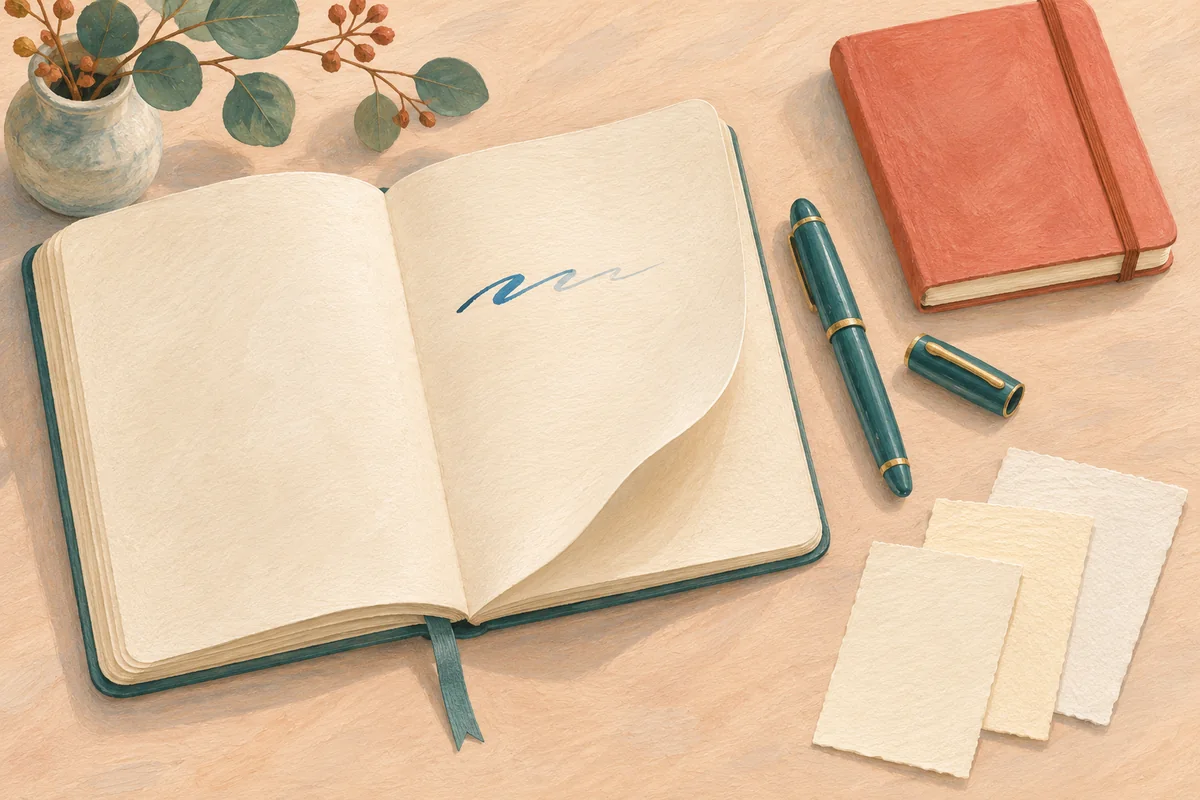
Before offering the pair, confirm decoration, quantity, exact destination-country availability and delivered pricing with the supplier; pricing remains quote-needed. The AI-generated editorial illustration is not a product photograph or evidence of a writing test.