A new cooking thermometer does not have to display exactly 32.0°F in an ice-point check to be working within its specification. Before rejecting a gift sample—or adjusting it—find the exact model's accuracy tolerance and its approved checking procedure. The useful question is whether the reading meets that specification under the stated conditions.
For a culinary school's alumni gifts or a restaurant team's take-home cooking kit, buy the support information along with the instrument. This guide concerns contact-probe gift thermometers, not clinical devices or approval of equipment for a professional kitchen. If you have not selected the measurement method yet, start with probe versus infrared cooking gifts.
Ask for the accuracy specification, not just the display resolution
A screen showing tenths of a degree is not, by itself, a promise of accuracy to one tenth. Request the manufacturer's accuracy statement for the relevant temperature range, plus the manual's checking and adjustment instructions. Put those documents in the purchase record before approving decoration.
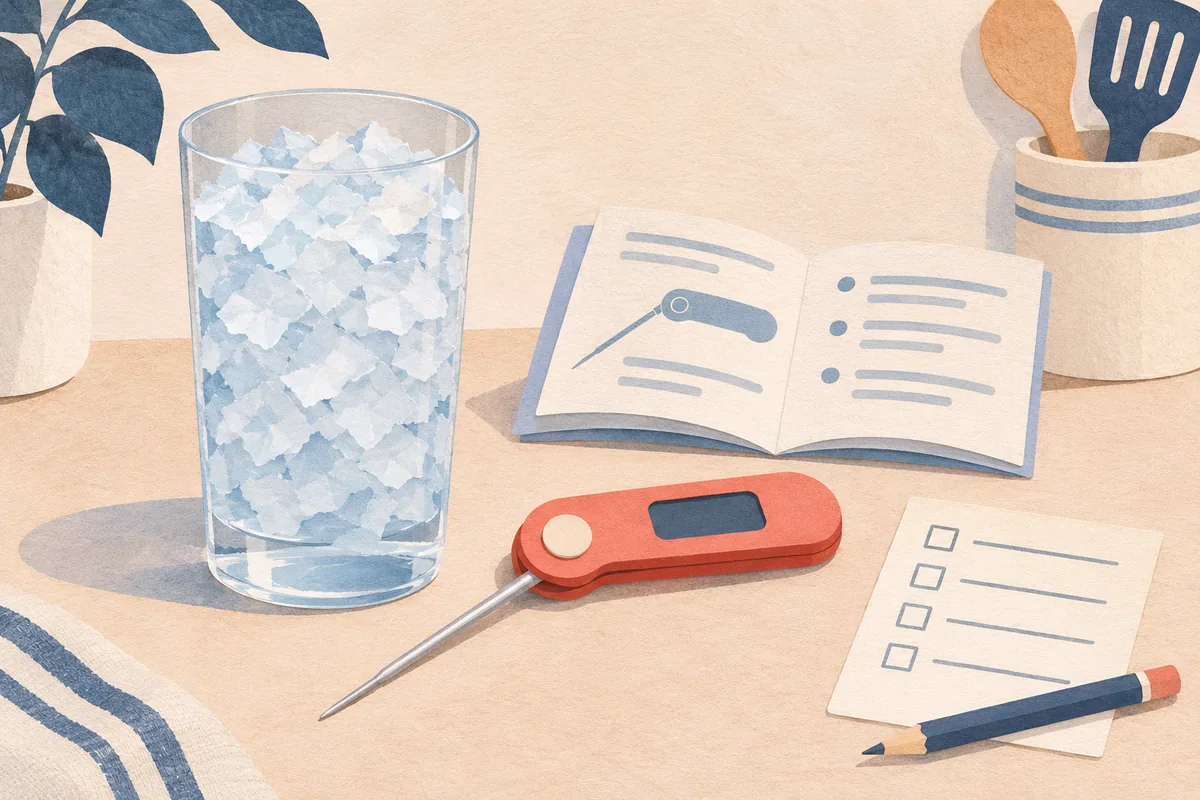
ThermoWorks' accuracy guidance says readings within the published tolerance do not require adjustment. It warns against comparing two unverified thermometers, checking in cooking food, or using an incorrectly prepared ice bath. Probe placement matters: avoid the vessel's sides and bottom, and follow the specified immersion method. Boiling-water checks also require the correct local boiling point rather than assuming 212°F everywhere.
Worked example: a nonzero reading is not automatically a failure
Illustrative arithmetic—not a product specification or a test result: suppose a hypothetical model's manufacturer allows ±1.0°F at the ice point. With a correctly prepared reference condition of 32.0°F, its stated interval would be 31.0–33.0°F. A stable reading of 32.6°F falls inside that interval; 33.4°F falls outside it.
This calculation alone cannot validate a real instrument. The checking setup, applicable specification and manufacturer's decision procedure still have to be right. Do not transfer this invented tolerance to a model with a different specification, and do not round away a borderline result to make a sample pass.
What the ice check cannot promise
Fluke's thermometer-calibration guidance distinguishes an ice-point field check from documented professional calibration. A single temperature does not establish accuracy across the operating range, and setup conditions affect the result. Where traceability or multi-point performance matters, a casual ice check is not a substitute for the appropriate calibration process.
That distinction belongs on the gift insert. Use wording such as “follow the manufacturer's accuracy-check instructions,” not “certified accurate after our ice test.” This article reports no Brand Sauce testing. A staff member receiving a personal gift should not have to guess whether it is approved workplace equipment.
A release-or-hold checklist for the buyer
- Identify: record the exact model, manual version, units and accuracy specification. If the supplier cannot provide them, hold the sample approval rather than inventing a tolerance.
- Plan: use the model's approved checking procedure, including bath preparation, immersion depth, settling time and permitted water exposure. A glass containing a few ice cubes is not an automatic reference standard.
- Record: write down the observed reading, conditions and specification before making any adjustment. Keep the sample's identity attached to the record.
- Route: an in-spec result needs no buyer-improvised correction. An out-of-spec or uncertain result goes back through setup review and manufacturer support. Adjust only where the model's instructions explicitly permit it; otherwise seek service or replacement.
- Hand over: include the manual and a named program support contact. Ask the supplier how recipients in each destination country obtain help, and whether decoration affects that route. Confirm delivered decorated pricing separately; it remains quote-needed until agreed.
Set the return responsibility before distribution using the gift warranty and support handoff. One sample record is not evidence that every unit in a shipment was tested.
Copyable sample-review record
Model / sample identifier: ____.
Manufacturer manual and accuracy specification: ____.
Approved checking procedure: ____.
Units / applicable tolerance: ____.
Setup and observed reading (if checked): ____.
Outcome: within specification / hold for setup review / manufacturer support.
Adjustment permitted by manual: yes / no / unresolved.
Recipient instructions and country-specific support route: ____.
Decision owner and date: ____.
Buying rule: approve a documented instrument and a usable support path—not a promising-looking decimal display.
Editorial image: AI-generated illustration, not a product photograph or test result. Primary guidance checked November 9, 2026.