No: “one scoop” is not a transferable coffee recipe. Before adding a measuring scoop to a café’s customer gift or a team coffee kit, match the actual scoop to the coffee and the printed brewing instructions. A scoop is a convenient volume measure; a gram marking is not a built-in scale.
The buying decision is simple: include a scoop for an easy starting routine, or specify a scale when the gift promises a repeatable dose in grams. Do not print a precise gram claim on a generic scoop without checking the finished sample.
Two manufacturer examples show why the scoop matters
Hario’s M-12SV measuring scoop is described as holding around 12 grams of ground coffee. By contrast, the OXO grinder-with-scale instruction manual describes one OXO scoop as approximately 8 grams of medium-ground coffee. Those are item-specific approximations, not competing definitions of a standard scoop.
The examples explain specifications; they are not a Brand Sauce product shortlist or a promise of decoration or country availability. Hario’s UK listing was marked out of stock when checked for this post. Confirm the exact offered item, destination, stock and decoration before ordering; custom pricing remains quote-needed.
OXO also defines the “cup” in that manual’s dose table as 5 fluid ounces. Copying “one scoop per cup” onto a card for a large mug loses both pieces of context: which scoop and how much water. Write the actual water quantity instead.
Choose the instruction before choosing the accessory
- One supplied ground coffee and one demonstrated brew: a scoop can be useful if the card names that coffee, grind, fill method and water quantity. Treat the recipe as a starting point.
- Recipients use their own beans or change coffees often: make grams the primary instruction and a scale the measuring route. A scoop can still transfer coffee into the weighing bowl.
- No scale in the gift: do not write instructions that require one without saying so. Either provide a tested scoop-based starting recipe for the supplied coffee or let recipients choose a simpler gift.
- Whole-bean bag: decide whether dosing happens before or after grinding. Do not silently use a ground-coffee scoop specification for whole beans. First check whether the recipient has a grinder using our whole-bean versus ground coffee gift checklist.
A pre-print dose check for the actual gift set
This is a proposed approval procedure, not a Brand Sauce product test. Have the café or roaster approve the brewing recipe; the buyer’s job is to keep the accessory, instructions and packed contents consistent.
- Identify the sample. Record the offered scoop’s model, material, markings and care instructions, plus the coffee and grind supplied in the kit. Verify any supplier volume specification rather than assuming a tablespoon equivalent.
- Define the fill. Use a level scoop without tamping or a heap, unless the approved recipe explicitly requires another method. Photograph the intended fill for the proofing team.
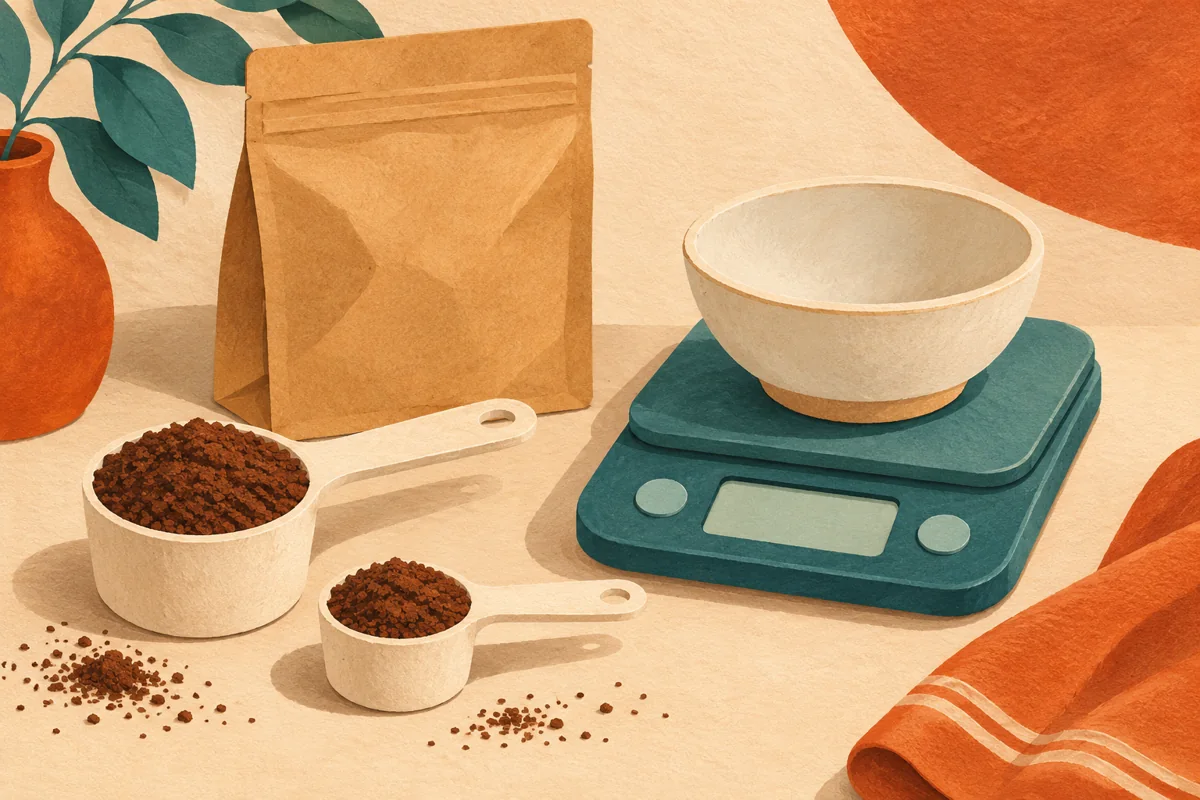
- Check the mass. Put a bowl on a suitable gram scale, tare it, fill and empty the scoop into the bowl, and record the reading. Repeat five separate fills, taring each time. Record the individual results, not just an average.
- Make the claim fit the result. If the fills do not support the proposed dose instruction, change the scoop or card. Do not turn a five-fill check into a universal accuracy guarantee. Recheck when the coffee, grind or scoop changes.
- Approve a complete brew. Use the supplied coffee, exact accessory and proposed card. Check the water amount, brewer capacity and practical serving size with the recipe owner.
- Proof the decorated sample. Keep any original measurement marks legible and decoration clear of food-contact areas unless that placement is specifically approved for the finished item. Pack its care instructions with the kit.
If the kit includes a pour-over brewer, the scoop is only one compatibility check: use the matching-filter checklist before approving the box contents.
Worked example: the same card, a different dose
Illustrative arithmetic, not measured results or a brewing recommendation: suppose a recipe owner specifies 24 grams of coffee. Using the manufacturers’ approximate figures above, that would suggest two 12-gram scoops or three 8-gram scoops. A card that merely says “two scoops” would instead suggest about 16 grams with the smaller scoop. The example shows why changing an accessory during sourcing requires reviewing the card, not just the packaging fit.
For a precise 24-gram instruction, weigh 24 grams. For a no-scale gift, approve a practical starting recipe for its particular coffee and scoop, and explain that recipients can adjust to taste.
Copyable packing-proof card
- Coffee: name, whole bean or ground, grind specification.
- Brewer: model or intended brewing method.
- Dose: ___ grams; or ___ level fills of the included scoop as an approximate starting dose.
- Water: ___ mL or ___ grams, as specified by the recipe owner—not simply “one cup.”
- Equipment required but not included: ___.
- Approval record: scoop model, sample readings, recipe owner, proof date and care instructions.
Release rule: a substituted scoop means a new instruction check. If nobody can identify which scoop the recipe refers to, pause the printed insert rather than asking the recipient to guess.
Editorial image: AI-generated illustration, not a product photograph or dose-test result.