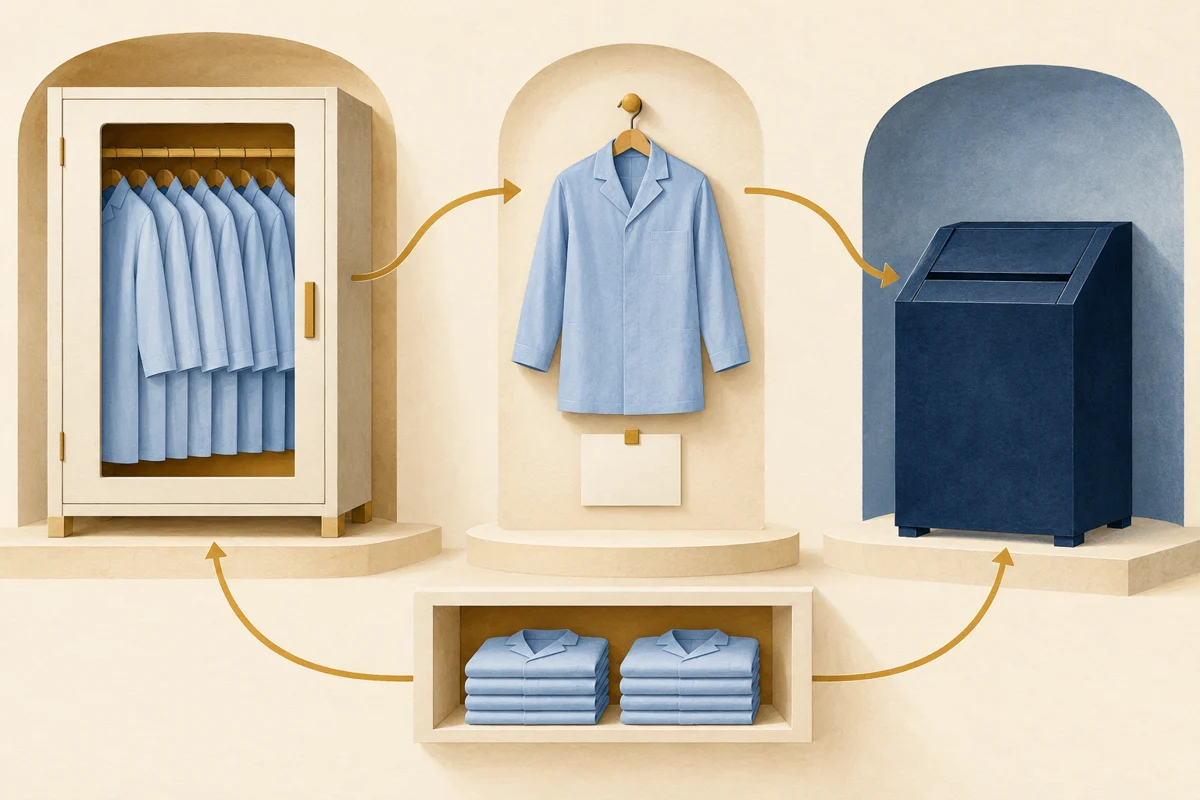
For food-production apparel, buy a working garment cycle—not just enough coats to dress the current headcount. Define how approved clean garments reach each shift, where used items go, who releases replacements and what happens when the next clean delivery is late. Keep optional employee merchandise outside that cycle unless the plant explicitly approves it for the relevant work.
A company store can collect sizes and replenishment requests. It cannot, by itself, establish that a garment is ready to enter a production area. This guide addresses the gap between purchasing clothing and keeping the plant supplied with the right clothing at the point of use.
Publisher perspective: Brand Sauce publishes this purchasing framework as a company-store provider. The workflow below is our recommendation, not a claim that Brand Sauce provides industrial laundering, food-safety certification or these software controls. This guide uses U.S. FDA and OSHA sources checked October 18, 2026. Have the plant's food-safety and worker-safety owners confirm applicable requirements; exact service scope, products and prices are quote-needed.
Define what makes a garment ready for issue
Start with a release rule: a garment is available only when it is the approved specification, the correct fit, in acceptable condition and through the plant's required preparation process. A newly delivered parcel is not automatically ready for the changing room. Likewise, a coat returned by a laundry provider should enter the agreed receiving and release process rather than bypass it because the supplier is familiar.
Under 21 CFR 117.10, personnel working in direct contact with food, food-contact surfaces or packaging materials must follow hygienic practices sufficient to protect against contamination and allergen cross-contact. The provision addresses suitable outer garments, effective hair restraints where appropriate, and storing personal belongings away from exposed food and equipment-washing areas. It does not supply a universal number of coats per employee or a purchasing formula.
Turn the plant's requirements into an approved specification before requesting quotes. Record garment construction, permitted decoration, size range, allowed work areas and care route. Ask the food-safety owner to resolve features such as pockets, closures, trims and name labels for the actual process. Do not substitute an attractive promotional jacket for an approved coat simply because both are described as workwear.
For operations subject to the hazard-analysis requirement, 21 CFR 117.130 requires evaluation of hazards for the foods handled at the facility and includes sanitation and employee hygiene among the factors to consider. The procurement consequence is straightforward: a generic supplier catalog is an input to the plant's review, not a replacement for it.
Track five garment states, not one inventory total
Our recommended operating model separates garments by whether they can actually solve the next shift's need. A spreadsheet may be sufficient for a small operation; the important distinction is the state, not the sophistication of the tool.
| State | Meaning in this proposed workflow | Owner's next action |
|---|---|---|
| Approved and ready | Released for issue in the specified size and work area | Protect storage and issue against an identified need |
| Issued | Assigned to a person or current shift | Record the expected return or replacement route |
| Used and awaiting care | Not available for clean issue | Move through the designated collection process |
| In care or transit | With the laundry operation or moving between locations | Confirm expected return and investigate missing quantities |
| Held or retired | Damaged, questionable, mismatched or no longer approved | Resolve, repair under the approved process, or remove from service |
Never count the same coat as both issued and ready. Keep a returned-but-unreviewed garment out of the available total. If a vendor's report says “on hand,” ask which states that number includes. Ten coats at a laundry facility do not cover ten people arriving for work now.
Separate by size and approved use as well as total quantity. A reserve of the wrong sizes can look healthy on a financial report while leaving a particular employee without a usable replacement. Record an acceptable alternative only after approval; do not let the stockroom improvise equivalence.
Size the reserve around the care cycle
Build the stock calculation with operations and the laundry provider. The inputs are the number of people needing each garment, expected changes, collection and return timing, delivery gaps, size distribution and the contingency the plant intends to cover. Include temporary staff and visitors where they use the same approved system.
Illustrative planning example—not a regulatory minimum or measured client result: suppose 24 people each need one clean coat per working day. The agreed cycle must cover three working days before the next released return is usable. That creates a baseline of 72 coat uses to supply during the interval. If the plant deliberately adds one extra day of coverage, the planning quantity becomes 96 coats, before adjusting for size mix, held items or additional changes.
The arithmetic is simple; the calendar is not. Confirm whether a delivery arriving during the morning shift can serve that shift or only the next one. Check weekend collections, holidays, receiving hours and how long inspection or other required preparation takes. Do not count a coat that returns after issue time as available earlier that day.
Additional changes can make the baseline inadequate. Ask the plant owner to define replacement triggers and then plan the reserve accordingly. Do not solve a shortage by stretching garment use beyond the approved practice. Also avoid double-counting: if the three-day cycle already includes laundry turnaround, do not add that same interval again under a different label.
Design the clean and used handoffs before ordering
Map four physical locations: receipt, released clean storage, issue and used collection. The map should show who can move garments between them and how questionable items are isolated. This is a proposed control map for the plant to adapt, not a prescribed facility layout.
Ask prospective service providers to explain the custody boundary. Does the delivery team put garments into the designated clean storage, or leave containers at receiving? Who counts shortages? How are repairs and replacements identified? What happens when a return includes another department's specification? Agree on the evidence needed to close an exception instead of relying on an informal promise that the next delivery will fix it.
For a company-store order, route operational garments to the approved receiving point when that is what the plant requires. Do not default to home delivery merely because it is convenient for employee gifts. Keep personal recognition parcels out of the production garment receiving queue; different purposes need different instructions.
A practical handoff record can be short: date, specification, size, quantity, state, sending party, receiving party and unresolved exception. Do not collect personal information that the process does not need. Individual issue may need an employee reference; pooled stock may only need a department and shift.
Give urgent replacement its own ordering path
A torn garment halfway through a shift is not the same purchasing event as a new-hire size selection. Design two routes: immediate access to approved local replacements, and replenishment that restores the reserve afterward. The first route serves the worker now; the second repairs inventory.
Make the emergency owner explicit for every shift, including nights and weekends. Define who may issue the spare, where it is stored, how the used item is handled and who raises the replacement request. An online store that is available around the clock does not mean a decorated garment can arrive around the clock.
For longer-term replenishment, the order should identify the approved specification revision and destination. If the supplier proposes a substitute, pause that line for the plant's approval. A discontinued fabric or closure is not merely a catalog maintenance problem when the original item was reviewed for a particular use.
Worker protection is a separate approval dimension. OSHA's general PPE requirements call for workplace hazard assessment and suitable, properly fitting protection where required. The standard generally requires employer payment for covered PPE, with specified exceptions, including everyday clothing. Do not classify every food-hygiene garment as worker-protective PPE—or use a discretionary gift allowance to bypass an applicable employer obligation. Ask the safety owner to classify the task and item.
Choose rental, owned stock or hybrid by responsibility
No-inventory ordering is useful for optional merchandise with flexible timing. It is not a substitute for an immediate clean replacement reserve. For operational garments, compare the whole service responsibility rather than the decorated unit price.
| Model | Potential fit | Question to settle before buying |
|---|---|---|
| Rental with agreed care service | A recurring issue-and-return cycle with defined service ownership | Who owns shortages, size changes, repairs and emergency coverage? |
| Owned garments with separate care | The plant wants purchasing control and has a suitable care arrangement | Who coordinates replenishment and tracks items outside the plant? |
| Bulk approved reserve plus replenishment ordering | Immediate availability matters, with ongoing size-specific replacement | What triggers replenishment before the reserve is depleted? |
| On-demand optional employee merchandise | Off-duty recognition clothing with recipient choice | How will the store make its non-production status clear? |
For the commercial comparison, use our uniform rental versus company-store guide. Here the decisive test is narrower: can the chosen combination supply released, correctly sized garments when the next shift needs them? Bulk or a rental arrangement can be the appropriate operational choice even when employee gifts use on-demand fulfillment.
Request separate quote lines for garments, decoration, care, collection, delivery, replacement, repairs and any service minimums. Identify which responsibilities remain with the plant. An inexpensive purchase can still leave an unstaffed receiving or repair task; a service fee is useful only if its scope closes the intended gap.
Use this six-case readiness review
Before expanding the program, walk through these cases with the stockroom, operations, food-safety owner and provider. Record the actual response, not only whether somebody says it is supported.
- New starter in an uncommon size: identify approved clothing available for the first shift and the replenishment route.
- Mid-shift replacement: show the authorized spare, issue owner and used-garment destination.
- Late clean return: calculate the remaining usable coverage by size and identify the escalation owner.
- Damaged item in a returned batch: demonstrate how it is held without inflating ready stock.
- Supplier substitution: stop the unapproved revision from becoming an automatic repeat order.
- Employee gift delivery: show that an optional sweatshirt cannot be mistaken for production-approved clothing.
Use the broader company-store pilot acceptance guide for ordering and support checks. A successful checkout is only one part of this operational review.
Frequently asked questions
Can employees choose their own food-production clothing?
They can choose among options the plant has approved for the assigned use, including appropriate sizes. Keep unrestricted preference separate from operational eligibility. Our employee-choice gifting guide applies to the optional recognition collection, not permission to replace controlled workwear.
Does this require a particular laundry method?
This guide does not prescribe one. The plant must establish the suitable care process for its garments and operations, then verify that the chosen service supports it. Do not interpret an ordinary consumer care label as approval of the plant's complete hygiene process.
Should every facility use the same coat quantity?
No. Shift patterns, changes, size mix, turnaround and contingency plans differ. Recalculate after a service-calendar change or staffing change; do not carry forward an old headcount multiplier without checking its assumptions.
The buying decision is complete only when the garment's next journey is defined: ready storage, issue, used collection, care, review and return to availability. Give optional merchandise a separate path, and select the supplier combination that can keep the operational cycle working.
Hero: AI-generated conceptual illustration of garment circulation, not an actual facility or prescribed hygiene layout.