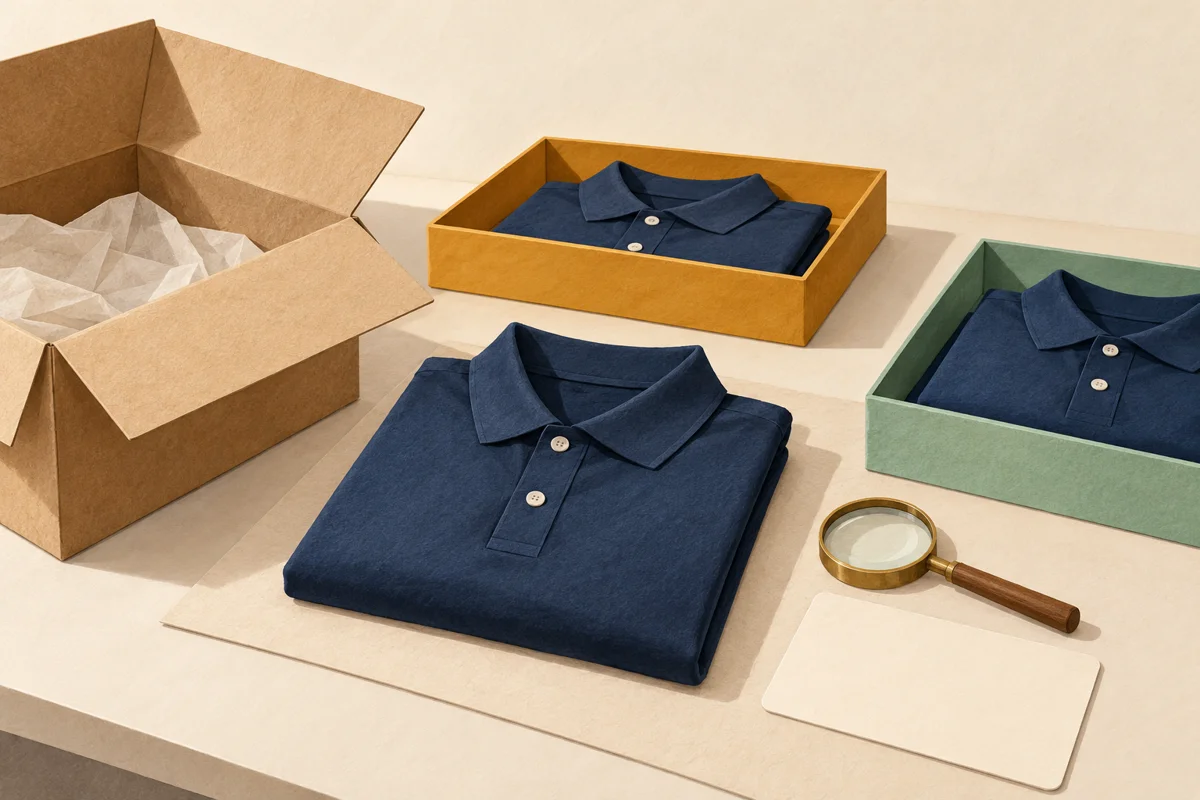
A restaurant company store should separate required workwear from optional employee gifts, then approve workwear by task—not just by job title. Kitchen preparation, table service and off-duty merchandise can share a brand without sharing the same product rules. Give employees choice within an approved workwear collection, and keep recognition gifts in a clearly separate collection.
The decision is bigger than whether everyone wears black. A server who occasionally plates desserts, a manager covering the line and a dishwasher moving into prep can cross the boundaries of a simple “front of house/back of house” catalog. The ordering system needs to reflect the work people actually do.
Publisher perspective: Brand Sauce provides company merch stores. This guide is our purchasing and operating framework, not a claim that a store certifies food safety or includes every control described below. Confirm local requirements with the restaurant’s food-safety lead and regulatory authority; confirm product, decoration, fulfillment and platform capabilities with the supplier. Sources checked October 3, 2026.
1. Start with three collections, not one uniform wall
Separate the purpose of each purchase before choosing products. Otherwise, a welcome-gift allowance can become the accidental budget for required work clothing, or a popular sweatshirt can look like an approved kitchen layer simply because it appears beside an apron.
| Collection | What belongs here | Who decides | What checkout must clarify |
|---|---|---|---|
| Food-handling workwear | Specific approved garments and hair-restraint options for the assigned tasks | Operations and the food-safety lead, with wearer fit input | Approved task, exact item, care route and replacement process |
| Service and guest-facing workwear | Approved shirts, aprons and layers for defined service duties | Operations and brand owner | Where it may be worn and what changes when duties change |
| Optional employee merchandise | Recognition apparel, bags and other personal-use gifts | Program owner and recipient | Optional gift; not automatically approved for food-handling work |
These are purchasing categories, not a complete workplace safety classification. Any task-specific protective equipment belongs under the restaurant’s established safety process, not a general gift-selection workflow.
You do not necessarily need three separate websites. Clear collections, product descriptions and an approval procedure can work. If the platform cannot restrict items by role, use manager-issued order lists or reviewed requests instead of implying the software enforces a boundary it does not.
2. Make food-handling approval a documented gate
The FDA Food Code is a model used by jurisdictions to develop their own rules. FDA lists a 2026 edition; publication of a new edition does not establish which requirements your location has adopted. Record the applicable local rule or authority guidance in the internal uniform specification.
Two provisions in the 2026 model Food Code are particularly relevant: section 2-304.11 addresses clean outer clothing, and section 2-402.11 addresses effective hair restraints. The latter includes a limited exception for specified employees presenting minimal contamination risk. It is not a blanket exemption for everyone called a server or host.
Translate that distinction into a task review. Ask the person responsible for food safety to approve the actual headwear and clothing arrangement for each task. A logo cap should not gain approval merely because it matches the restaurant’s colors. Likewise, moving a product into the “kitchen” collection does not establish its suitability.
Use a small approval record that a purchasing coordinator can actually maintain:
- Task: the work the person will perform, including occasional cover duties.
- Location: the restaurant and applicable local requirements.
- Approved item: manufacturer, style, color, available fit options and permitted decoration.
- Conditions: required accompanying items, care arrangements and use limitations.
- Decision: named approver, date and review trigger.
Review triggers should include a product substitution, a care-process change and a change in duties. A new embroidery color might need only brand approval; a different garment construction needs the relevant operational review too. Keep those decisions distinct so routine design changes do not obscure substantive ones.
3. Check the care process before approving the logo
A garment can look suitable in a sample box and still be a poor match for your laundry arrangement. Get the exact care instructions for both the blank garment and the finished decorated item. Then have whoever manages cleaning confirm that the proposed process is compatible.
For a concrete manufacturer example, SanMar’s Port Authority A520 specification calls for cold washing, non-chlorine bleach only when needed and low tumble drying. Its A703 specification calls for warm washing, no bleach and low tumble drying. Both are full-length aprons, but their instructions are not interchangeable. Neither listing alone establishes compatibility with your commercial laundry process or suitability for a particular kitchen task.
These are specification examples, not promises of Brand Sauce stock, decoration availability or pricing. Confirm the exact product and destination before ordering. Where cleaning requirements and product care instructions conflict, choose a compatible garment and process; do not ask employees to improvise.
Write the cleaning handoff alongside the product approval: who collects used garments, who cleans them, where clean replacements are kept and who removes damaged items from circulation. The uniform rental versus company-store guide addresses the separate decision of whether to own or contract out that service.
Before a rollout, review a finished sample after the intended care process. Look at fit, closures, ties, seams, logo appearance and legibility of the care information. Record the process used and what changed. This is a practical purchasing trial, not a laboratory certification or proof of a guaranteed garment lifespan.
4. Size the clean reserve around the next usable delivery
On-demand production can support replenishment, but it cannot replace a clean garment needed during today’s shift. A restaurant may need local workwear stock even if optional employee gifts are made only after selection. That is a deliberate hybrid program, not a failure of the store model.
For pooled garments such as approved aprons, start with three quantities: expected clean-item use before the next usable laundry return, a contingency reserve, and the clean usable stock already available. Count garments, not employees. One employee may need more than one item during a shift, while an item awaiting laundry is not a clean spare.
Illustrative example—not a measured usage rate: a café expects six apron-wearing assignments per day over three days before its next usable laundry return. Its planning assumption is one clean apron per assignment, plus six contingency aprons. That gives a clean-stock target of 6 × 3 + 6 = 24 aprons at the start of the interval. If 15 clean usable aprons are already on hand and no other clean stock will arrive first, the gap is nine.
This is not the café’s total lifetime purchase requirement, nor a recommendation that one apron always lasts a shift. Change the assumptions when actual change frequency or laundry turnaround differs. For individually assigned shirts or coats, calculate coverage by employee and usable size rather than treating all garments as a shared pool.
Track the reason whenever the reserve is used: unexpected staffing, an in-shift change, delayed laundry, damage or a fit mismatch. Those reasons tell you whether to add stock, fix the cleaning schedule or broaden available sizes. Simply ordering more of the most common size may not resolve the shortage.
5. Offer employee choice without making work readiness optional
Required workwear and a thank-you gift solve different problems. As a program-design recommendation, provide a defined route to the required approved kit before inviting employees to spend a recognition allowance. Have HR confirm the applicable payment and reimbursement rules separately; a merchandise budget is not a substitute for that review.
Within workwear, useful choice might mean approved fits, lengths or equivalent styles rather than unrestricted products. Show those options together and provide a private way to request a fit alternative. If none works, route the request to a named person instead of telling the employee to select the closest available item.
For optional gifts, broader choice can make sense. A bag or off-duty layer need not follow the same selection rules as a kitchen apron. Keep the distinction visible in the invitation and product description, not buried in terms at checkout.
A simple wording pattern is: “This collection contains optional employee gifts. These items are not automatically approved as work uniform.” For required items: “Choose from the styles approved for your assigned duties. Contact your manager before substituting another product.” Adapt the language to the policy your team actually uses.
6. Decide the awkward cases before opening orders
A useful launch review asks what happens when the standard path fails. Assign a response owner and an acceptable temporary arrangement for each case; do not rely on an urgent online order as the entire recovery plan.
| Situation | Required decision | Recommended owner |
|---|---|---|
| A server begins helping with food preparation | Recheck the approved kit against the new tasks before the reassignment | Shift manager and food-safety lead |
| A preferred garment is unavailable | Approve an equivalent for task, fit, care and branding; do not substitute on appearance alone | Operations and purchasing |
| A required size will arrive after the start date | Arrange an approved usable alternative and a dated replacement plan | Hiring manager |
| The laundry return is delayed | Use the documented clean-stock contingency and revise the return expectation | Location manager |
| An employee selects a gift sweatshirt for kitchen use | Explain the collection boundary and direct them to approved workwear | Manager or store support |
Keep a record of the decision, not a long email chain nobody can find. For substitutions, retain the originally approved specification and the reason the replacement was accepted. For a wider network, our franchise uniform rollout framework covers the division of responsibilities between headquarters and locations.
7. Pilot the program through one complete operating cycle
Do not judge readiness only by whether checkout works. Take a small representative group through selection, receiving, fit review, actual assigned use, care and replenishment. Include someone who changes duties and someone who needs a less commonly stocked fit.
At the end, answer five questions:
- Could each person identify the collection and products approved for their work?
- Did the correct usable items arrive before they were needed?
- Did care instructions reach the person or service doing the cleaning?
- Could a manager resolve a shortage without inventing a new rule?
- Did optional gifting remain separate from required-kit completion?
Record exceptions by cause and owner. A size-selection mistake, an inaccurate stock promise and a delayed laundry return require different fixes. Review those records before adding more styles or expanding to more restaurants.
If you are evaluating a Brand Sauce company merch store, bring the approved task matrix, product specifications, care requirements and start-date needs to the discussion. Request confirmation of the exact assortment, destination coverage, decoration, ordering controls and quote. A store can support the program; it does not replace the restaurant’s operational approval.
Restaurant uniform program FAQs
Can kitchen and front-of-house staff use the same shirt?
Possibly, if the specific garment, care process and intended tasks are approved. A shared color or logo is not enough to establish equivalence. Keep the approval task-specific even when one item appears in multiple collections.
Does a company store eliminate the need for spare uniforms?
No. A made-to-order replacement has a production and delivery timeline. Keep a justified clean reserve for workwear that may be needed before replenishment or laundry returns. Optional gifts can follow a different fulfillment model.
Should recognition gifts count toward required uniform quantities?
Track them separately. An optional gift only becomes usable workwear if it meets the same approval and availability conditions as the required kit. Otherwise, counting it can hide a real uniform shortage.
Is this a food-safety compliance checklist?
No. It is a purchasing and program-design framework. The restaurant’s responsible team must establish the applicable requirements and operating procedures for its location, tasks and products.