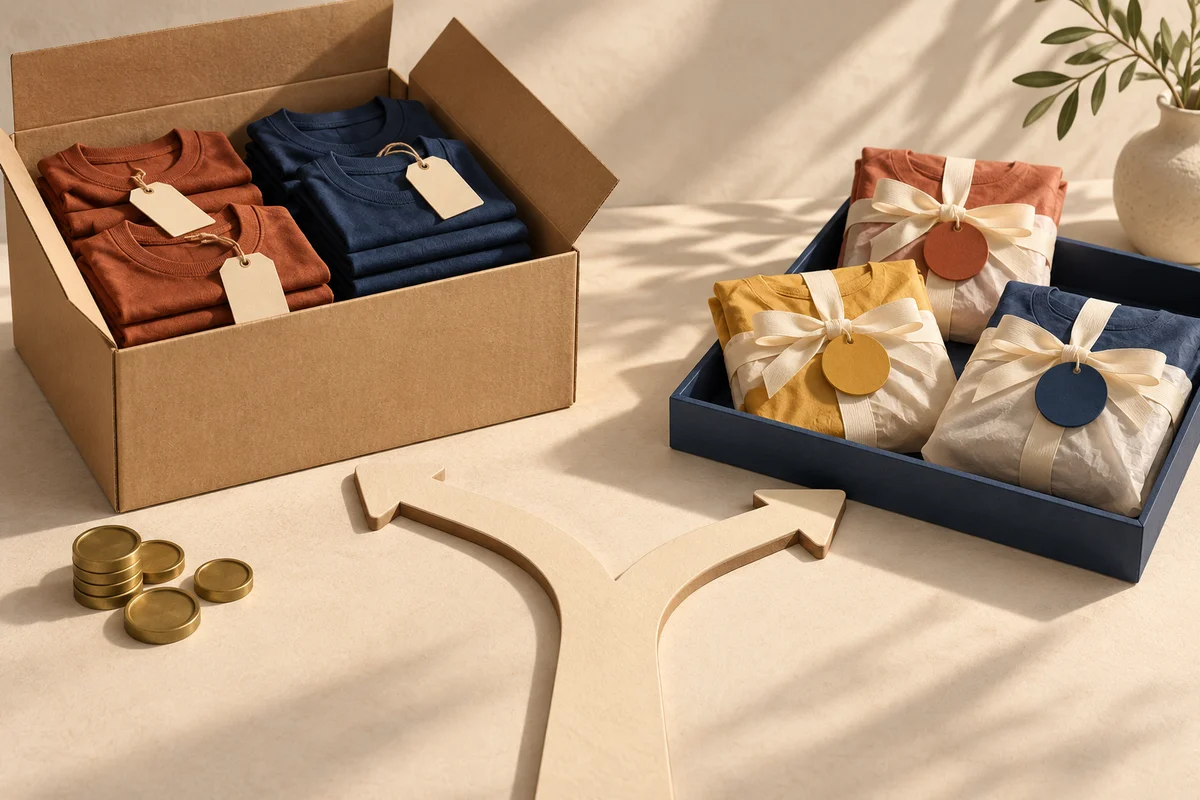
Choose between Printfection—now presented as Swag Pro—and a managed no-inventory company store by deciding what you want to outsource: storing and sending merchandise you have committed to, or arranging merchandise after recipients order it. Both can remove packing work from your team. They do not necessarily remove the same purchasing decisions.
For a buyer with approved event stock, repeated kit shipments and a replenishment owner, a warehouse-centered program deserves a serious look. For an employee store with uncertain size demand and ongoing individual orders, investigate a managed made-after-order route first. A mixed program may need both. The useful comparison is the commitment behind each order, not which homepage promises less administration.
Publisher perspective: this is Brand Sauce editorial content, not an independent ranking. We sell managed company-store services. Official pages were checked October 22, 2026. Recommendations below are our buying framework, not measured customer outcomes. Exact products, destinations, implementation scope and prices require confirmation in a current quote.
Start with the current offer, not an old Printfection review
The official Printfection site now identifies its offering as Swag Pro. Its company-store documentation describes native branded storefronts, inventory-based product selection, voucher or credit redemption, purchases, and multiple audience-specific stores. The FAQ places Stores on the Enterprise plan. That is a meaningful company-store option—not merely a tool for sending a box manually.
The official fulfillment page describes storing merchandise in fulfillment centers and handling packing and shipping, with tracking and inventory updates. This establishes a warehouse-based route worth evaluating. It does not establish that every possible product or custom arrangement must follow an identical production model. Ask the provider to identify the route for each item in your proposed assortment.
Brand Sauce’s managed company-store offering includes curation, setup, branding guidance and fulfillment support, with company-funded, self-pay and bulk-order use cases. Our homepage describes a no-inventory proposition. Treat that as the starting scope to validate against your actual garment, decoration and destination—not permission to assume every custom kit or specialty item is available one at a time.
Both approaches can involve people who help run the program. Calling one “managed” should not imply the other has no support. Instead, ask which recurring tasks remain with your organization after launch.
Separate three commitments hidden inside “no inventory”
Use three questions to unpack a proposal:
- Where does the finished merchandise sit? In your office, at a fulfillment partner, or not yet produced?
- When do you commit money? Before anyone selects a size, when a recipient submits an order, or at another agreed milestone?
- Who decides replenishment? Your buyer, the service team under an approved rule, or an automated process with a defined limit?
A warehouse can eliminate your physical closet while leaving you responsible for choosing how many medium shirts to buy. A made-after-order route can reduce that finished-stock forecast while still requiring assortment approvals, an available blank garment and a production window. Neither is a magic transfer of every business decision.
Ask separately about legal ownership, payment timing and responsibility for obsolete goods. Do not infer these from warehouse location. Record the commercial answer in the proposal or agreement, including what happens if a campaign ends early or the brand changes. This guide is a procurement framework, not an interpretation of either provider’s contract.
Match the route to the demand you actually have
| Program condition | Route to investigate first | Decisive evidence |
|---|---|---|
| Existing approved merchandise needs recurring distribution | Stored-inventory fulfillment | Accepted inbound items, receiving process, usable counts and dispatch terms |
| Employee sizes and selection timing are uncertain | Managed made-after-order store | Orderable size range, production trigger and replenishable blank availability |
| Everyone needs the same kit for a fixed event | Bulk or stocked kit route | Approved complete kit, assembly window and delivery contingency |
| Core event products are predictable; optional apparel is not | Hybrid program | Separate inventory rules and clear recipient delivery expectations |
| A unique product requires batch manufacturing | Quoted batch route | Minimum commitment, sample approval and plan for remaining units |
This matrix recommends an investigation order, not a universal winner. A stocked route can be the responsible choice when the merchandise is already approved and demand is credible. A one-item route can be the responsible choice when the alternative is guessing a large size distribution. Use the on-demand versus bulk decision guide for the underlying quantity and cost comparison.
When the Printfection / Swag Pro route merits a shortlist
The official pricing page lists storage allowances and product-SKU limits by plan, shows Company Swag Stores under Enterprise, and describes a platform fee plus product, fulfillment and shipping charges. It also describes bringing in existing merchandise when onboarding. The displayed plans direct buyers to sales rather than publishing a complete base subscription price.
Those are useful starting points if you want an organized distribution operation around a defined assortment. Before choosing, demonstrate your real cycle: receive goods, reconcile counts, release an individual shipment, handle an exception, and request replenishment. A compelling storefront demo does not answer whether your team will keep the shelves appropriately stocked.
Ask how reserved units, damaged units and available units are represented. A total count is not enough if some items cannot be sent. For existing stock, provide an itemized manifest and ask what conditions make an item acceptable for receiving. Get the proposed treatment of mixed cartons, unmarked sizes and missing product records before moving goods.
Also define the internal owner who can authorize another production run. Outsourced fulfillment is easier to evaluate when someone still owns the brand’s quantity and funding decisions. If nobody can take that role, make that gap visible during procurement rather than discovering it after the first stockout.
When to investigate Brand Sauce first
Investigate Brand Sauce first when the central need is a curated, branded employee ordering experience and you want to avoid buying a finished size assortment before people choose. The relevant question is whether the proposed program can fulfill the actual selection after order placement, with responsibilities and timing your team accepts.
Bring three representative items to the discussion: a commonly ordered garment, an awkward size or destination case, and a product with special presentation requirements. Ask for the production route and constraints for each. A straightforward shirt should not stand in for proof that a multi-item gift box works the same way.
Use our published company-store examples to discuss navigation, assortment and brand presentation. They are examples of storefronts, not evidence of another client’s contract, private operating workflow or service-level performance. Your own requirements still need acceptance checks.
Do not select Brand Sauce on an unsupported assumption that it is cheaper. Compare a scoped proposal with a scoped proposal. If a tightly scheduled bulk event is the main requirement, ask for the batch option too; avoiding inventory is not more important than meeting a well-defined delivery need.
Normalize the quote before comparing totals
Give both providers the same planning brief, including recipient destinations, expected selection mix, decoration, packaging and service period. Separate the first funding commitment from the cost of sending the first parcel. Otherwise a stocked proposal and an order-triggered proposal can look incomparable simply because they recognize costs at different moments.
| Quote field | What to request | Why it changes the decision |
|---|---|---|
| Merchandise commitment | Units purchased, timing of payment and permitted quantity changes | Shows exposure before recipient demand is known |
| Program fees | Setup, subscription, service scope and relevant limits | Prevents comparing a base plan with a more complete service |
| Order-level costs | Decoration, packing, fulfillment and destination-specific shipping | Reveals the cost of actual recipient deliveries |
| Exceptions | Returns, replacements, storage overages and inventory exit | Identifies costs missing from a normal-order demonstration |
| Countries | Exact item, production location, destination and applicable charges | A broad shipping claim is not a country-by-product commitment |
For an illustrative planning exercise—not a supplier quote—suppose you buy 120 shirts at an assumed $24 each and distribute 90 during the review period. The merchandise cash outlay is $2,880; dividing it by 90 gives $32 per distributed shirt, with 30 shirts still held. That does not mean the remaining shirts are worthless or that $32 is an accounting expense per shirt. It shows how utilization changes a cash-based comparison.
Compare that with the quoted cost of producing and delivering the same 90 selected shirts through the other route, then add each route’s relevant fees. Do not add the purchase price of the 30 remaining shirts a second time as “waste.” If they will serve next quarter’s demand, model that second period. If they will become obsolete, show that assumption explicitly.
A hybrid can solve two different demand patterns
An illustrative employer might keep a known event handout in stock while letting staff order optional apparel individually. That is not evidence from a client program; it is a useful way to divide stable demand from uncertain preference.
The hybrid needs two operating rules, not just two suppliers. Identify which items are stock-controlled, which are produced after ordering, and whether a recipient may receive separate parcels. Define who pays for each shipment and how support explains different arrival dates. See our one-box versus separate-shipment guide before promising a unified gift presentation.
Give the stocked portion a replenishment threshold and the made-after-order portion a substitution rule. Review them independently. An empty shelf and an unavailable blank garment may look identical to a shopper, but they require different operational fixes.
Run a five-part acceptance exercise
- Ordinary order: select an approved item, fund it through the proposed mechanism and trace the order to a clear fulfillment state.
- Unavailable size: show what the shopper sees, whether an order can still be placed, and who authorizes the alternative.
- Real destination: confirm an actual planned country and address type for the exact product, without using a generic shipping map as proof.
- Funding exception: demonstrate the agreed treatment of cancellation, employee-paid value and restored gift eligibility.
- Program exit: explain outstanding orders, retained inventory, artwork, reports and remaining balances.
Use synthetic recipients for the demonstration and agree separately before placing any real sample order. Save the observed result, not just the sales answer. Mark each requirement as demonstrated, contractually confirmed, unresolved or not included. This prevents a possible custom feature from quietly becoming an assumed launch feature.
If you already have a provider, use the swag-provider migration checklist to connect the exit discussion to a controlled handoff. Do not move merchandise or disable an old store until open obligations have an owner.
Copyable shortlist decision record
- Primary demand: recurring stocked sends, recipient-led orders, fixed-date event or mixed.
- Inventory commitment: exact goods, quantity, payment point, ownership and leftover responsibility.
- Service ownership: who curates, approves artwork, maintains availability, replenishes and resolves exceptions.
- Recipient promise: selection range, funding rules, destination coverage and delivery expectations.
- Comparable quote: same item mix, service period, quantities and destination assumptions.
- Evidence: demonstrated workflow, current proposal and unresolved gaps.
- Decision: selected route, reason, accountable owner and next review date.
Frequently asked questions
Is Printfection still a relevant name to search?
Yes. The official site uses Swag Pro branding while retaining Printfection URLs and references. Check the current official offer and the contracting documents rather than relying on an older review’s names or package details.
Does outsourced storage mean I no longer have inventory risk?
No. Moving goods out of your office answers a location question. Your agreement and purchasing decisions determine who pays for remaining stock, replenishment and eventual removal. Ask those questions explicitly.
Is a managed no-inventory store always faster?
No. Finished stock can support a different dispatch workflow from merchandise that still needs production. Compare an approved delivery commitment for the exact order, including stock availability, decoration, assembly and transit.
Which option should an employee-choice program shortlist first?
Start with the route that matches its main uncertainty. If size and style demand are unknown, investigate made-after-order fulfillment. If approved goods already exist and distribution is the bottleneck, investigate stored fulfillment. If both are true, price and test a hybrid.