Not automatically. A branded eraser that works for ordinary graphite notes is not, by that fact alone, a good match for a colored-pencil workshop. Buy around the actual pencil, paper and correction the participant needs to make—not the eraser’s color or the size of its logo area.
For an adult community-art class or a university sketching event, decide whether people need to lighten a passage, lift a small highlight or remove a mistaken line enough to draw over it. Those are different acceptance criteria. “Erases colored pencil” should not become a promise that every heavily worked page returns to untouched white.
Choose the correction before the giveaway
Manufacturer descriptions show why one generic eraser specification is insufficient:
- Shaping and selective correction: Prismacolor describes its Premier Kneaded Eraser as moldable and suitable for highlighting and erasing colored pencils, chalk, charcoal and pastels. That makes a kneaded format a candidate when the instructor wants a small, adjustable contact area.
- A product expressly intended for colored-pencil marks: Tombow’s MONO Sand Eraser uses natural rubber latex and silica grit. Its stated applications include colored pencil and several kinds of ink. That specification is not interchangeable with an unspecified promotional block eraser.
These are manufacturer examples explaining the selection problem, not a claim that either product is available for customization through Brand Sauce. Neither description verifies performance on your printed handout or the exact layered drawing your instructor plans to demonstrate.
If the session actually uses graphite rather than colored pencils, start with the HB-versus-2B workshop pencil decision. Do not buy a specialist eraser simply because it sounds more capable.
A one-sheet sample card for the instructor
Use the following as a proposed purchasing check, not a laboratory standard or a test we have performed. Request samples of the exact candidate models, and use spare sheets of the actual workshop paper.
- Record the pairing. Write down the eraser model, pencil brand/range and color, paper specification and whether the sheet is preprinted. Keep an untouched area beside each trial.
- Make representative marks. Include a light outline, the class’s normal shaded area and a layered patch if layering is part of the lesson. Have the instructor make these as they would during class.
- Name the required correction. For each patch, choose “lighten,” “lift a highlight” or “remove enough to redraw.” Define success before trying the eraser; do not quietly change the goal afterward.
- Use the maker’s instructions. Try the intended correction on each patch. Record remaining color, smearing and any visible change to the sheet’s surface. Stop if the paper begins to deteriorate rather than rubbing until a preferred result appears.
- Draw again. Apply the next planned pencil stroke over the corrected area. The correction is not useful for this class if the next step no longer behaves acceptably.
- Check the printed area separately. If learners work on a preprinted outline or worksheet, try a spare printed section too. Record whether the original print remains usable.
Mark each required task pass, limited use or reject, with a short reason. A model that only lightens the layered patch may still suit a highlighting lesson; it should not be sold to attendees as a complete reset button.
Put the teaching tool ahead of the imprint
If the best-performing eraser cannot accept the proposed decoration, ask about branding a sleeve or kit card instead. Confirm that option with the supplier; it is not a universal customization capability. If direct printing is proposed, request the finished decorated sample and repeat the relevant checks, including whether the imprint transfers to the paper or interferes with normal handling.
For the companion sketchbook, the paper-and-binding selection guide helps keep the paper decision connected to the activity. Approving the eraser on unrelated office paper leaves the kit’s actual pairing unverified.
Copy this into the quote request
Adult colored-pencil workshop kit. Required correction: [task]. Pencil: [exact range]. Paper/printed worksheet: [specification]. Approved eraser: [model and sample reference]. Accepted limitations: [notes]. Decoration: [confirmed sleeve, card or direct-print arrangement]. Materials requirement: [organization’s requirements and supplier documentation]. Quantity: [number]. Destination country and delivery date: [details]. Please confirm customization, availability, packaging and price; any substitute needs a new pairing check.
Keep material claims separate: Tombow’s cited sand eraser is described as non-PVC but also explicitly contains natural rubber latex. Non-PVC does not mean latex-free. Verify any required material exclusion for the exact supplied model rather than inferring it from appearance.
Bottom line: approve a usable pencil–paper–eraser combination, then approve how the kit carries your brand. Availability and decorated pricing remain quote-needed until the supplier confirms the model, quantity and destination.
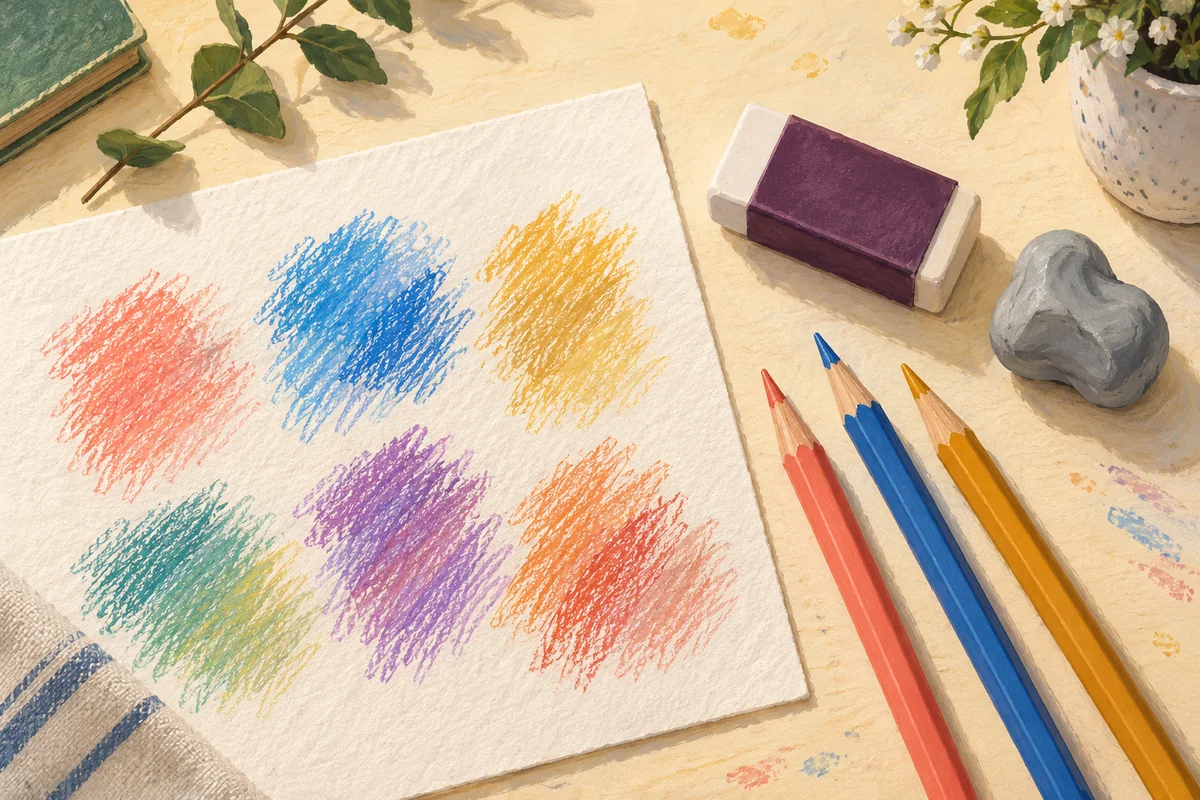
Editorial image: AI-generated conceptual illustration, not a product photograph or an erasing demonstration.