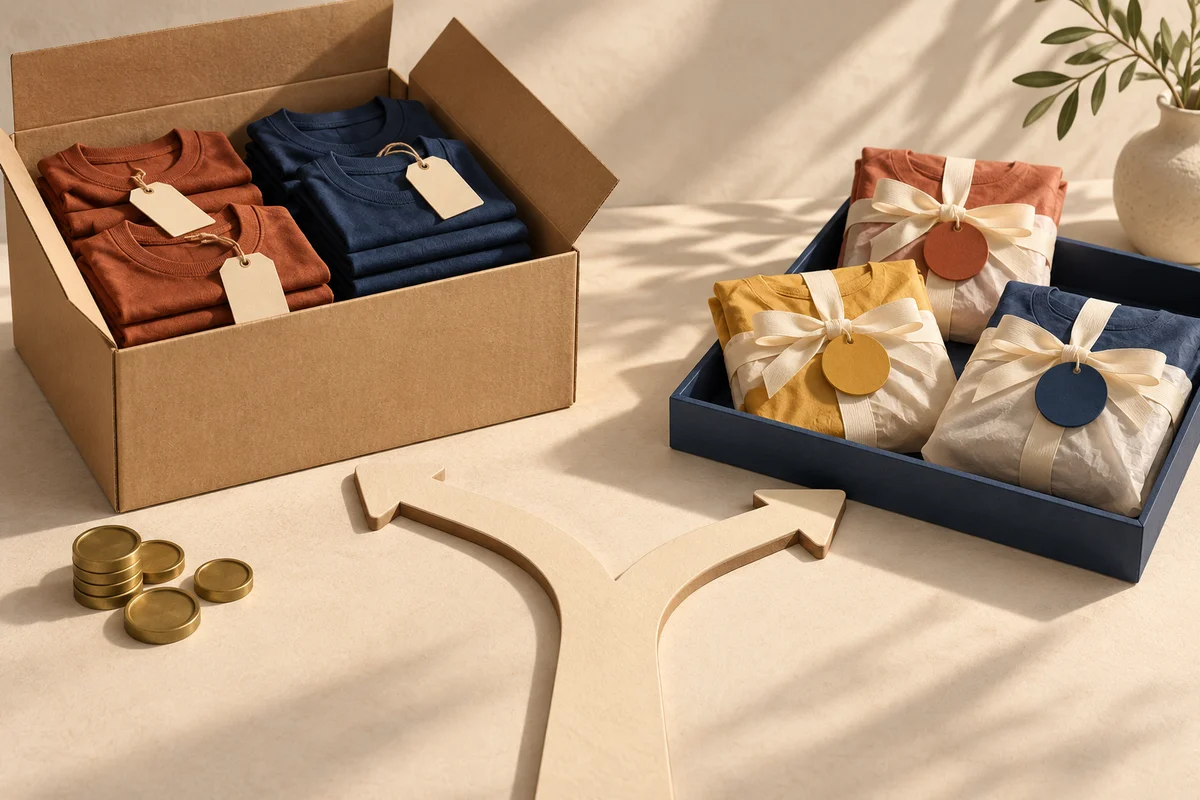
If you are evaluating SwagUp alternatives because you do not want to pre-buy employee merchandise, start with Brand Sauce for a managed company store, Goody for eligible gift-acceptance-led swag, and Printful for a self-managed print-on-demand operation. These are different operating models, not interchangeable versions of a swag kit service. If the priority is a coordinated box ready to dispatch from stock, SwagUp may still be the right fit.
The deciding question is not “Can you send one gift?” It is “What must we buy before we know who wants it?” That includes decorated products, packaging, inserts and any stock required to keep a promised delivery experience running.
Publisher disclosure: Brand Sauce publishes this guide and sells company-store services. We feature ourselves for the managed, no-inventory-store use case, not as an independent overall winner. Provider statements were checked September 28, 2026. Recommendations below are our analysis of those statements, not hands-on comparative test results. Confirm the exact assortment, destinations, fees and service scope in a written proposal.
First, define what you want to stop managing
“We do not want inventory” can mean three different things. You may want boxes out of the office. You may want someone else to track stock. Or you may want to stop committing money to merchandise before recipients choose it. A warehouse can solve the first two without solving the third.
Write one requirement before looking at demos: “For our ongoing employee program, no decorated merchandise should be purchased until an eligible recipient selects it.” If that is too restrictive for your actual needs, change it explicitly: perhaps standard gifts follow that rule, while an annual meeting gets a separate bulk order.
Also distinguish product inventory from supplier availability. Producing after an order does not make a blank garment, preferred color or decoration method permanently available. The risk changes from owning unused finished goods to managing production availability and recipient expectations.
| Your real problem | Model to investigate | What still needs an owner |
|---|---|---|
| Boxes occupy the office | Outsourced storage and fulfillment | Purchasing, replenishment and leftover decisions |
| Uncertain demand leaves unused merchandise | Production triggered by individual orders | Assortment, availability and production expectations |
| HR cannot maintain an online shop | Managed company-store service | Eligibility, budgets and brand approval |
| Everyone needs the same box for a fixed event | Bulk production and coordinated kitting | Final counts, receiving plan and deadline buffer |
What SwagUp offers—and why some teams keep it
SwagUp’s current FAQ describes swag-store fulfillment from pre-purchased inventory, with some preorder options once minimums are met. It also describes recipient selection of available products and apparel sizes. That means a store interface and recipient choice do not, by themselves, remove the inventory commitment.
Its Help Center’s Autoship FAQs makes the dependency concrete: Autoship needs associated inventory. Depending on configuration, exhausted items stop being selectable or submissions continue and shipments must be scheduled after replenishment. This is a stock-backed dispatch workflow, not evidence of production starting automatically for every individual redemption.
There are good reasons to choose that workflow. Merchandise already produced can be prepared ahead of a launch, and a deliberately assembled kit can create a consistent opening experience. SwagUp’s FAQ describes pre-curated, pre-produced packs and warehouse fulfillment. If those are the outcomes you value, replacing them with separate made-to-order items may be a downgrade for your program.
One detail deserves written confirmation: SwagUp’s FAQ describes monthly storage fees, while its fulfillment and storage guide describes storage billing every six months. We would not build a budget from those statements alone. Ask which terms apply to your proposal, including the storage period, measurement basis and treatment of remaining stock when the program closes.
A focused shortlist by buying model
| Option | Reason to shortlist | Key qualification |
|---|---|---|
| Brand Sauce | A company-branded store built for you without inventory buying as the default | Confirm every required product, decoration and destination; do not assume custom kits follow the same rules |
| Goody | On-demand swag items made after gift acceptance | Separate qualifying items from products with minimums and warehoused programs |
| Printful | Print-on-demand production connected to an operation your team manages | Assign ownership of the employee storefront and program rules; check packaging restrictions |
| Keep SwagUp for a defined use case | Pre-produced kits and stock-backed sends | Plan the inventory commitment and replenishment process deliberately |
This shortlist is organized by the job each model can do. It is not a price ranking, a claim that every product has a one-unit minimum, or a complete inventory of providers.
Brand Sauce: start here for a managed company-store brief
Brand Sauce’s current company-store offering describes building a custom-branded store without requiring inventory and advertises no order minimums. That makes it a relevant starting point when the brief is an ongoing employee shop rather than a one-time box assembly project.
Our recommendation is conditional: choose this direction when you want a branded destination and help operating the merchandise program. Bring an actual product list, not just a headcount. Have us confirm the service responsibilities, payment arrangement, decoration approvals, support process and destination coverage before you promise anything to employees.
The tradeoff is that a managed arrangement still needs an internal decision-maker. Nobody outside your organization can decide who is eligible, what your logo rules allow or which department should pay. And a no-inventory assortment should not be assumed to include every specialty product or a fully custom multi-item box under identical terms.
Goody: investigate acceptance-led individual gifting
Goody’s swag catalog and FAQ say most swag is produced after gift acceptance, distinguish eligible no-minimum products from items with quantity minimums, and state that warehousing involves minimums and fees.
That makes Goody worth investigating when the central experience is sending a gift for someone to accept, rather than starting with a pre-bought kit. Do not generalize the on-demand rules to every branded product or custom box. Compare the actual recipient journey and required items. A provider can support both models without every item being available in both.
Printful: investigate when your team will own the shop
Printful advertises print-on-demand production without order minimums. It is a relevant alternative when your team wants production and fulfillment behind a storefront it operates, rather than treating the vendor as the owner of the employee program.
Its custom-packaging guidance also illustrates a useful exception: branded packaging can involve approval, inventory storage and fulfillment charges, with use tied to the fulfillment location. A made-to-order product does not automatically make the entire presentation inventory-free.
For this route, name the person responsible for access, eligibility, allowances, messages and support escalation. Do not assume those employee-program requirements are included merely because a production integration exists. Our managed-store versus Printful guide explores that responsibility decision in more depth.
Compare the delivery promise, not just the product list
Give every finalist the same short brief. For example: a continuing new-hire program, uncertain monthly hiring, a choice of apparel or a non-apparel gift, several delivery destinations and one internal budget owner. This is an illustrative brief, not a Brand Sauce client story.
Then add the condition that matters most: must everything arrive in one box, on a particular date, with a printed card? Those requirements can change sourcing, assembly and inventory needs. Ask for a written exception list rather than a broad “yes, we do kits.”
- Production trigger: purchase order, minimum quantity reached, recipient acceptance or completed checkout?
- Cash commitment: what is funded before anyone chooses, including packaging or deposits?
- Parcel plan: one shipment or several, and who explains split deliveries?
- Item failure: if one component is unavailable, does the whole gift wait?
- Address correction: what is the last point at which delivery details can change?
- Program closure: what happens to products, packaging and unused balances?
Packaging approval should cover protection as well as appearance. UPS’s packaging guidance explains cushioning, limiting movement and selecting an appropriate packing method. A handsome presentation box is not proof that a mug, bottle and electronic accessory will travel safely together. Request a representative packed sample before approving the experience.
Build two budgets: commitment and delivered cost
A single per-item price hides the distinction you are trying to evaluate. First compare money committed before employee demand is known. Then compare the cost of fulfilling the expected selections over the same time period.
| Budget line | What to ask |
|---|---|
| Initial commitment | Which merchandise, packaging, setup or prepaid services must be funded before launch? |
| Per fulfilled gift | What product, decoration, handling and delivery charges apply to this destination? |
| Ongoing program | Are there service, storefront, storage or support charges? |
| Exceptions | Who pays for corrections, replacement sizing, failed deliveries or substitutions? |
| End of period | What remains usable, what remains committed and what will require disposal or transfer? |
Illustrative calculation, not provider pricing: suppose a stock-backed program purchases 100 kits at $40 each and ships 70 in the planning period. Merchandise cash committed is $4,000; $1,200 of that purchase remains represented by 30 unshipped kits. It is not automatically a loss: the kits may serve future recipients. A hypothetical made-to-order alternative at $48 for each of 70 fulfilled gifts commits $3,360 to merchandise during the same period.
Neither figure includes freight, service fees, storage, taxes or replacements. If all 100 kits are used, the merchandise-only comparison changes to $4,000 versus $4,800. Do not add the $1,200 remaining inventory to the original $4,000 as if it were a second cash expense. Use actual quotes and expected utilization; our on-demand versus bulk guide explains the wider model choice.
Run a small pilot that tests the exceptions
Approve a pilot before moving the entire program. Small does not have to mean superficial. Select ordinary orders plus one apparel-size choice, one non-apparel option and one destination that matters to your actual workforce. Agree who records the outcome and what would require a correction before launch.
Have the vendor demonstrate an unavailable item, an unclaimed invitation and an address correction in a test workflow. Do not deliberately create a bad live shipment. Inspect what the recipient sees, who receives the support request and whether finance can connect the final charge to the relevant program.
Use only the recipient information needed for fulfillment and administration. The FTC’s business data-protection guidance recommends limiting collection and retention to legitimate needs and restricting access. Ask where addresses are stored, who can export them and how retention is handled; avoid building a second permanent address spreadsheet simply to monitor orders.
Keep existing orders and stock separate during transition. An alternative can handle new demand while the current provider finishes committed shipments. Our swag-provider migration checklist covers the handoff without leaving open orders behind.
Frequently asked questions
Is SwagUp a bad choice if we want employee choice?
No. Its store model includes choice from the available assortment. The question is whether you also want to avoid buying merchandise ahead of that choice. Treat those as separate requirements.
Does shipping one kit at a time mean there is no minimum order?
No. A fulfillment request can be for one parcel even when producing or purchasing the underlying merchandise required a larger commitment. Ask for both the production minimum and the dispatch minimum.
Will an on-demand alternative always cost less?
No. Avoiding unused goods can matter, but a well-used bulk order may have better unit economics. Separate shipments, specialty packaging and service charges can change the comparison. Evaluate the same products, destinations and delivery promise.
Can we use both a no-inventory store and a kit provider?
Yes, if responsibilities are clear. Use the store for unpredictable individual demand and a separately planned bulk program for a fixed event or standardized launch. Keep budgets and recipient communications distinct so employees know which experience applies.
What should we bring to a Brand Sauce discussion?
Bring the recipient groups, desired products, countries, timing, budget rules and any nonnegotiable packaging requirements. We can discuss the company-store fit against that brief. A useful proposal should make exceptions visible before you launch, not after the first employee asks where the rest of their gift is.
Provider source notes, checked September 28, 2026: SwagUp FAQ, storage guide and Autoship FAQs; Brand Sauce homepage; Goody swag catalog FAQ; Printful print-on-demand and custom-packaging guidance. Public descriptions are not substitutes for contracted terms. The illustration is conceptual, not a photograph of any provider’s facility or merchandise.