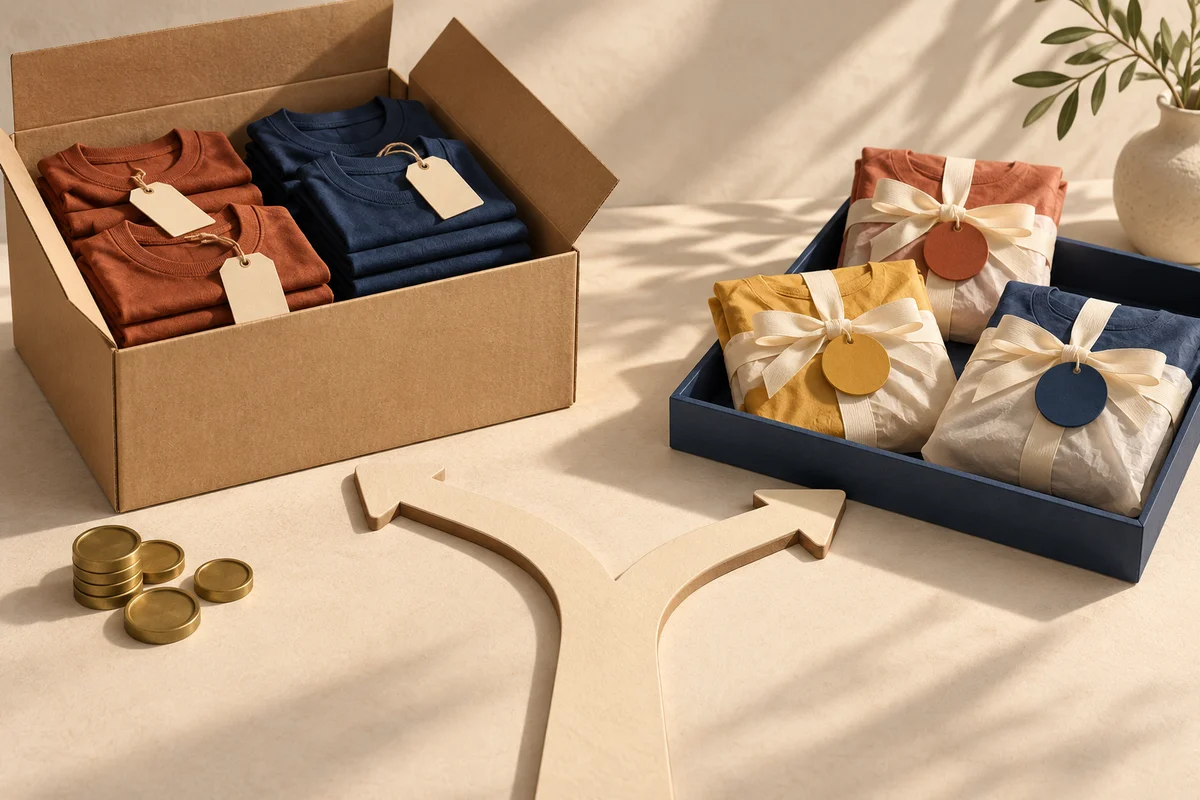
For a Swag.com alternative, shortlist Brand Sauce when you want a managed company store built around ongoing, made-to-order merchandise. Consider Printful when your team wants to manage designs and ordering itself. Keep Swag Pro in the comparison when stocked merchandise, coordinated distribution and recurring kits match the job. The deciding question is not which vendor has a storefront. It is what must happen before the next employee can receive an approved item.
Swag.com buyers may be trying to solve very different problems: eliminate a physical swag closet, stop forecasting apparel sizes, simplify employee choice, or combine event inventory with year-round gifting. Moving boxes into somebody else’s warehouse solves the first problem, but not necessarily the others. This guide compares those operating decisions rather than declaring one universal winner.
Publisher perspective: Brand Sauce publishes this comparison and sells managed company-store services. Brand Sauce appears first because of its fit for that specific brief, not an independent rating. Official service documentation was checked October 3, 2026. This is a document-based buying guide, not a hands-on platform test; prices and proposed configurations need confirmation.
Start with today’s Swag.com and Swag Pro offering
Do not build a shortlist around the assumption that Swag.com only sells bulk products. Its current service overview presents self-service purchasing alongside Swag Pro for ongoing programs, including branded stores, inventory warehousing, kits and an account team. Employee gifting is an explicit use case, not an incidental workaround.
The Swag Pro Stores documentation says stores are available to subscription customers. It describes vouchers, merchandise sales and an option to cover shoppers’ shipping. Consequently, “employees can choose” is not, by itself, a reason to switch. Ask whether the current configuration supports the benefit you want before commissioning a migration.
A stronger switching brief identifies a specific mismatch: buying sizes before people choose, an internal team that cannot maintain the assortment, a funding process that needs too much intervention, or an upcoming program with different delivery requirements. If the existing service can resolve that mismatch at an acceptable cost, staying can be a sensible outcome.
A practical shortlist by operating model
| Option | Put it on the shortlist when | Resolve before signing |
|---|---|---|
| Brand Sauce managed store | You want outside ownership of store setup and curation, with an on-demand path for recurring merchandise | Exact eligible products, service scope, order rules, destinations and total quoted cost |
| Printful self-managed route | Your team can own designs, assortment and the ordering workflow | Whether shared product links are enough or a separate storefront and funding configuration are needed |
| Swag Pro stocked program | You want to distribute a planned assortment repeatedly and can manage the purchasing commitment | Available stock by variant, replenishment ownership, subscription scope and outbound charges |
| Hybrid program | Fixed-date events and unpredictable individual gifting coexist | Which items use which fulfillment path, and how employees see those differences |
These are evaluation routes, not interchangeable packages. A fulfillment provider, a managed store and a stocked distribution program may each remove different work. Make the handoff visible before comparing their prices.
Brand Sauce: evaluate the managed, ongoing-store fit
Brand Sauce’s company merch store solution describes product curation, setup, branding guidance and fulfillment support, with public or private stores and company-funded or self-pay models. Its homepage describes an on-demand flow in which an ordered item is decorated, packed and shipped. Those are the relevant reasons to include it for a team trying to stop administering an ongoing store internally.
The buying discipline is to convert that service description into a written scope. Who adds an approved replacement jacket? Who notices that a selected color is unavailable? Who answers an employee whose order has not arrived? What can the program owner change without starting another setup project? A managed relationship should assign these responsibilities, not merely provide a login.
Request a quote against a small, real assortment rather than a generic platform promise. Specify each product, decoration, destination and expected ordering pattern. Require confirmation of any minimum, setup charge or exception for that selection. Do not interpret broad no-minimum positioning as proof that a complex custom kit or every decoration method has identical economics.
The tradeoff is dependence on the agreed service process. A team that wants to experiment with designs every afternoon may prefer direct design control. A team that needs hundreds of identical kits on a fixed date may prefer a planned batch. Brand Sauce is worth evaluating for either brief, but a managed on-demand store should not automatically displace a suitable bulk order.
Printful: distinguish product sharing from a full employee program
Printful MerchShare lets a template owner share a designed product for recipients to order in their chosen size and color. The owner can choose who pays. For owner-funded orders, its instructions describe confirming orders individually before payment and fulfillment. That can suit a bounded team project; recurring manual confirmations should be included in the administrative estimate.
For a connected-store approach, Printful’s cost guidance describes a free version without a required monthly subscription, while orders incur product and printing costs, shipping, applicable taxes and embroidery digitization where relevant. This is not the same as a complete employee-store budget. Add any storefront, configuration and internal operating costs for the route you actually choose.
The key tradeoff is ownership. Who curates the collection, checks artwork, funds orders, maintains the recipient experience and manages exceptions? Do not assume a supplier’s order fulfillment includes every HR policy. Conversely, do not buy a larger managed program if a small product-sharing workflow solves the actual need. Show your administrator the proposed process before deciding that either route is simpler.
When keeping a stocked Swag Pro program makes sense
A stocked model deserves serious consideration when the same approved products serve repeated campaigns and forecast demand is credible. It can also support a deliberate reserve for time-sensitive needs. The question is whether the organization wants to own that reserve, not whether inventory is inherently wasteful.
Swag Pro’s inventory FAQ states that minimum quantities depend on the product, shipping is charged when inventory is dispatched, and storage is included in the monthly pricing plan. Get the current proposal for your assortment; these facts do not establish the total cost of your program or a universal minimum across the catalog.
Stock visibility also needs precise language. The official inventory-stage guide distinguishes incoming merchandise, queued orders, physically stocked merchandise and stock already allocated to orders. A total warehouse count is not the same as what remains available for a new campaign.
Before a recurring gift launch, request availability by product variant and the replenishment decision owner. A shelf full of apparel is not useful to a recipient if the required size is already committed elsewhere. Retaining the current provider while changing the assortment or reserve policy may be less disruptive than changing systems.
Compare the same program, not three unrelated unit prices
Give each bidder the same operating brief: eligible recipients, expected claims, item choices, destinations, delivery windows, artwork and support responsibilities. Ask for a normal case and a stress case. The normal case shows routine cost; the stress case reveals what happens when the forecast is wrong.
Illustrative planning example, not a client result or supplier quote: a company expects 180 gift claims but would need to commit to 240 decorated units under one proposed stocked assortment. Its alternative is production against accepted orders. Those figures are assumptions for comparing proposals, not published vendor requirements.
| Cost or obligation | Stocked proposal | Order-triggered proposal |
|---|---|---|
| Merchandise commitment | 240 units × quoted decorated unit cost | 180 accepted orders × quoted decorated unit cost, subject to confirmed minimums |
| Delivery | Include inbound freight if charged, handling and outbound parcels | Include each parcel, any handling and split shipments |
| Program operation | Subscription, replenishment work and inventory administration | Store/service fees and order or assortment administration |
| Remaining obligation | 60 units still owned after 180 claims, if one unit per claim | Investigate failed orders, cancellations and any precommitted components |
The remaining 60 units are not automatically waste. They may be a useful reserve if future demand, artwork and size mix remain suitable. Equally, a lower upfront purchase is not proof of a lower annual cost: parcel charges and service scope can change the result. Keep cash committed, current-period expense and usable remaining stock separate in the review.
Then rerun the brief with fewer claims, a concentrated event order and a changed apparel mix. Ask bidders to state what becomes noncancelable and when. Our company swag cost guide provides the broader cost categories; this comparison is about applying the same assumptions to each operating model.
Use a five-case demonstration before switching
Do not let a polished storefront substitute for a demonstration of the work your team will perform. Give each shortlisted provider the following cases and keep a written result: demonstrated, configuration required, manual workaround, unavailable or quote needed.
- The next individual gift: show one approved item going to one eligible recipient without a new bulk purchase, or show the stock commitment that enables it.
- The depleted variant: show what the recipient sees when their size is unavailable and who approves a replacement.
- The fully funded order: show whether the employee owes anything at checkout, including delivery, and how the company sees the charge.
- The deadline order: distinguish production, stock release, packing and transit. Identify the point where the promised date becomes uncertain.
- The administrative absence: show how a colleague handles an order exception when the usual program owner is unavailable.
For any destination outside your initial domestic pilot, repeat the product-and-delivery check for that exact country. A worldwide shipping statement does not establish local production, identical assortment, landed cost or a specific arrival date. Record quote-needed details instead of filling the comparison table with assumed capabilities.
Use a hybrid when the jobs really are different
One supplier or store does not require one production method. A useful hybrid might hold a confirmed event allocation while ongoing employees choose from an order-triggered collection. Another might retain usable existing stock until depleted and introduce made-to-order replacements afterward. Neither approach requires labeling all leftover merchandise a mistake.
Make the distinction visible to administrators and recipients. A stocked kit and a separately produced jacket may have different arrival windows and cancellation rules. Avoid presenting them as one guaranteed delivery unless the provider confirms that fulfillment plan. Our on-demand versus bulk guide explains the wider tradeoffs.
If you change providers, agree what happens to open orders, existing inventory, artwork and remaining employee benefits before the new launch. Begin with a bounded cohort, reconcile it, and only then expand. Use the provider migration checklist for the handoff; choosing an alternative and executing the transition are separate decisions.
Frequently asked questions
Is Brand Sauce always cheaper than Swag.com?
No price conclusion is supported without comparable quotes. Match the products, decoration, purchasing commitment, deliveries and service responsibilities. A different unit price may reflect a different job.
Do I need to switch just to let employees choose?
No. The documented Swag Pro store already offers a shopping experience. Evaluate the funding, availability and management rules that sit behind that experience, rather than treating choice as exclusive to one provider.
Can Printful replace a managed company store?
It can be a route to fulfilling merchandise, but first map who owns the remaining store and employee-program work. Product sharing may be sufficient for a narrow project; a recurring program may need additional configuration and administration.
What is the best first step?
Write down one workflow that fails today and the evidence that would prove it fixed. Then compare a change to the current setup with one managed alternative and one self-managed route. Choose the option that resolves that failure with acceptable cost and ownership—not the longest feature list.