Choose Printify when your team wants to operate the merchandise program and select its production workflow. Shortlist a managed employee-store partner when you want someone accountable for running the program around your employees, funding rules and approved assortment. The important comparison is not simply who can print a logo. It is who decides what happens when the approved product, production route or employee order changes.
Printify deserves a serious evaluation for a team comfortable managing merchandise. A managed service deserves an equally specific scope review: “managed” is not proof that every exception, integration or destination is included. This guide focuses on the production-network decisions that make Printify different from a generic storefront builder.
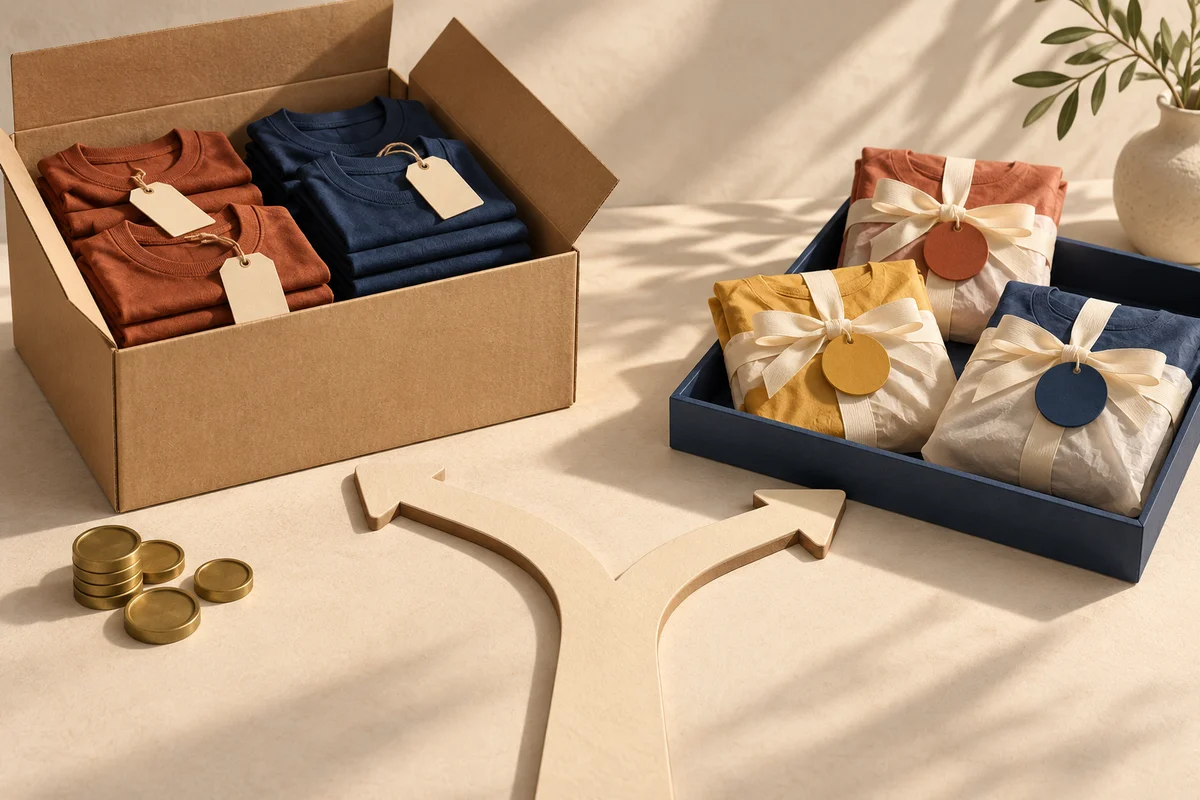
Publisher perspective: Brand Sauce publishes this comparison and sells company-store services. Our recommendation is based on operating fit, not an independent ranking or a claim of lower pricing. Official provider documentation was checked October 20, 2026. The image is an AI-generated conceptual illustration, not a photograph of either provider’s operations.
Start with the operating model, not the product catalog
Write one sentence describing the job: “Employees select one employer-funded item from an approved assortment, and our team wants a named owner for exceptions.” Compare that with: “We want to sell our designs and control the store and production choices ourselves.” Both are legitimate merchandise programs, but they create different acceptance tests.
Printify’s Pop-Up Store documentation describes a hosted store where customer payments go to Printify, which handles payment processing, printing, shipping and customer support. It supports a Printify address or custom domain. That is a meaningful ready-made selling workflow; it should not be dismissed as merely a production connection.
An employer-funded entitlement is a separate requirement. Ask for a demonstration of how your selected configuration identifies eligible employees, prevents unintended repeat claims and pays for the promised gift without requiring the employee to advance the money. The cited Pop-Up overview does not establish those controls. Treat them as unverified, not automatically unavailable across every Printify service or integration.
Brand Sauce’s current company-store positioning makes it relevant to a managed-program shortlist. Still, require a written answer for your particular funding method, destination, merchandise and support needs. Public positioning is not a project-specific statement of work.
Compare the work you retain
| Decision | Printify evaluation | Managed-store evaluation |
|---|---|---|
| Who operates the assortment? | Identify the internal person maintaining products, artwork and production settings. | Name who proposes, approves and updates the assortment; separate service work from your brand approval. |
| Who pays at checkout? | Demonstrate your chosen channel’s actual payment journey, rather than assuming a retail store is an employee allowance. | Demonstrate the agreed employer funding and any employee-paid upgrades. |
| What can change in fulfillment? | Review routing settings, acceptable substitutions and hold handling. | Require an equivalent written change-control policy, including subcontracted production. |
| Who resolves an exception? | Map platform support, storefront responsibilities and internal employee communications. | Specify the contact, response expectations and who funds the remedy. |
| How do you judge cost? | Include the selected product, shipping, channel costs and your operating time. | Include the quoted service scope, merchandise, shipping and retained internal work. |
Do not score a blank cell as a failure. Send the same questions to both options and classify each answer as documented, demonstrated or still open. A broad promise on a sales page is weaker evidence than a completed order and a written exception policy.
The key Printify decision: what may routing change?
Printify’s Order Routing setup guide describes routing to an alternative print provider, an adjustable additional-cost limit, and a choice between exact and similar product matches. Exact-only orders can be held when no exact alternative is available. It also warns that a design may be reduced if a substitute has a smaller print area.
Those controls are useful. The buyer’s job is to decide what they are allowed to optimize. A casual employee design shop might accept an approved comparable shirt to keep orders moving. A uniform program with a carefully selected fit and color may prefer a delay to an unreviewed change.
Separate three approvals: the blank product, the decoration appearance and the recipient promise. Keeping the same product does not, by itself, prove that a different production route has passed your appearance review. Conversely, using another provider is not proof that the result will be unsuitable. Ask what evidence is available and approve the route accordingly.
Use a short release rule: “This product may move to another approved producer only if the blank, color, size range, artwork dimensions and required packaging remain within the agreed specification. Otherwise hold it for review.” This is a recommended purchasing control, not a description of a built-in Printify rule engine. If the software cannot enforce the full rule, identify the manual check and its owner.
The same scrutiny belongs in a managed-store contract. Outsourcing coordination should transfer defined work, not make production changes invisible. Our employee-gift substitution guide explains the recipient-facing decision once an approved item cannot be supplied.
Branding must follow the actual fulfillment route
Printify’s branding reference lists packaging inserts, gift messages, printed neck labels and sleeve prints. Support varies by print provider and feature. The documentation explicitly limits inserts and gift messages to supporting providers; it does not promise that every product and route includes every branding option.
Build a small route-level specification instead of approving “custom packaging” as one checkbox. For each proposed product, record the decoration locations, whether a message is required, the expected packaging treatment and what happens if the order takes another route. Ask the provider to show the actual combination you intend to buy.
For example, a welcome program may require a manager’s note, while an optional employee-paid T-shirt needs only the correct artwork. Those should not inherit the same release criteria. If the note is the recognition moment, a correctly printed shirt without the note is an incomplete experience under your specification—even if the merchandise itself is usable.
Do not assume a managed partner automatically consolidates all products into one box or supports personalized inserts everywhere. Make those deliverables explicit, with country and product exceptions. If they are unnecessary, remove them from the brief rather than paying for a presentation requirement nobody values.
Separate product defects from employee-policy exceptions
The Pop-Up Store overview states that Printify handles customer support, offers qualifying damaged or defective product remedies subject to its reporting requirements, and does not support returns or exchanges for made-to-order products. It also says ordinary submitted orders cannot be edited; changes require cancellation and reordering, with an exception described for personalized products. Read the current conditions before launch.
An employee selecting the wrong size is not the same event as receiving a defective print. Decide whether the employer will fund a replacement, whether a manager must approve it and whether the original selection remains consumed. The supplier’s remedy policy and your employee goodwill policy can differ, but someone must fund that difference.
For either operating model, assign one recipient-facing owner. Employees should not have to determine whether an issue belongs to a print provider, the commerce platform, HR or the delivery carrier. An internal coordinator can serve that role in a self-managed setup; a managed partner may take it on if included in the agreement. Neither arrangement removes your responsibility to approve the policy.
Price the same completed program
Request comparable quotes using the same product specification, decoration, destination mix and support assumptions. Leave unknown amounts marked quote-needed. A displayed product cost is not a landed employee-program price, and a managed proposal is not comparable until its inclusions are clear.
- Merchandise: exact blank, sizes, colors, print locations, samples and any setup work.
- Delivery: actual destinations, parcel count, service level and any separately quoted cross-border charges.
- Operation: storefront or channel costs, product maintenance, reporting and exception handling.
- Remedies: employer-funded size mistakes, address corrections and replacements outside supplier coverage.
- Internal time: the work your own employees still perform under each proposal.
Illustrative only: suppose a self-managed pilot requires six internal hours a month and a managed proposal leaves two. At an assumed internal planning rate of $45 per hour, the four-hour difference is $180 per month. That is neither measured savings nor a vendor price. If the managed premium exceeds $180, the time assumption alone does not justify it; reliability, scope or other benefits would need their own evidence. If your team actually spends one hour, recalculate instead of retaining a convenient estimate.
Also compare bulk for a known event quantity. A fixed assortment, firm headcount and central delivery can justify a production batch, provided you account for size uncertainty and leftovers. A hybrid can reserve bulk stock for dated events and use made-to-order fulfillment for ongoing optional selections. See the on-demand versus bulk decision guide before assuming either service model requires one production method.
Run a five-case pilot before choosing
Use the same written brief for both candidates. These are proposed acceptance tests, not tests we claim to have performed.
- Normal employee order: verify the chosen item, payer, recipient communication and delivery outcome. Save the complete cost, not just the product line.
- Unavailable approved variant: demonstrate the configured hold or substitution process. Record who authorizes the change and whether the employee must choose again.
- Required branding: inspect the delivered sample for artwork dimensions and any mandatory message or insert. A mockup alone is not acceptance.
- Size mistake after production: walk through the actual policy and funding responsibility. Do not manufacture a support claim; use a documented scenario.
- Second destination or route: verify the specific product and service combination independently. One successful domestic order does not establish international capability.
Keep a one-page decision record: requirement, evidence, owner, unresolved condition and launch decision. Reject a launch with an unresolved must-have, not a provider because it has fewer marketing features. If you need a fuller rollout gate, use the company-store pilot acceptance framework.
Which option should make your shortlist?
Shortlist Printify when you want hands-on merchandise control and can assign a capable owner to production settings, product approval and the employee policies surrounding the chosen sales channel. Its documented routing and branding choices give you concrete configuration questions to evaluate, not reasons to dismiss the service.
Shortlist Brand Sauce or another managed partner when your primary need is an ongoing employee program and you want defined operational work assigned to a service team. Make funding, support, substitutions and exact country/product coverage part of the proposal. Choose on demonstrated fit; do not assume that managed means cheaper, unlimited or universally available.
Keep the program small or use a bulk purchase when the need is a single, predictable distribution. A permanent store can be unnecessary overhead if there is no ongoing selection or ordering problem to solve.
Frequently asked questions
Is Printify only a backend production tool?
No. Its documented Pop-Up Store includes a hosted selling and support workflow. Evaluate that separately from other integrations and from the employer-funded controls you require.
Does exact-product routing guarantee identical decoration?
Do not treat it as that guarantee. Exact product matching and your decoration acceptance standard answer different questions. Approve the artwork result and any production-route changes against your own specification.
Can we use Printify and a managed store together?
Potentially as separate programs, if the responsibilities are clear—for example, an optional design shop and a managed recognition program. This is not a claim of a native integration. Avoid duplicating employee entitlements or leaving employees unsure which support channel applies.
What should we ask Brand Sauce to quote?
Provide the assortment, recipient locations, funding journey, branding requirements, expected cadence and exception policy. Ask for inclusions, exclusions and a sample order. Exact pricing and capabilities for that brief remain quote-needed until confirmed.