Choose between Lands’ End Business and a managed employee company store by testing the exact assortment, funding rules and service responsibilities—not by assuming one has a storefront and the other does not. Lands’ End offers both self-managed and managed stores. Brand Sauce is worth evaluating when a company-branded, recipient-choice merchandise program is the central requirement. A coordinated apparel wardrobe may point you toward Lands’ End; neither fit judgment replaces a product-level quote and a working demonstration.
The most useful question is: Can employees order the approved products individually, with the right funding and support, without someone quietly buying unwanted stock? This guide turns that question into a purchasing brief, a comparison worksheet and a five-order acceptance test.
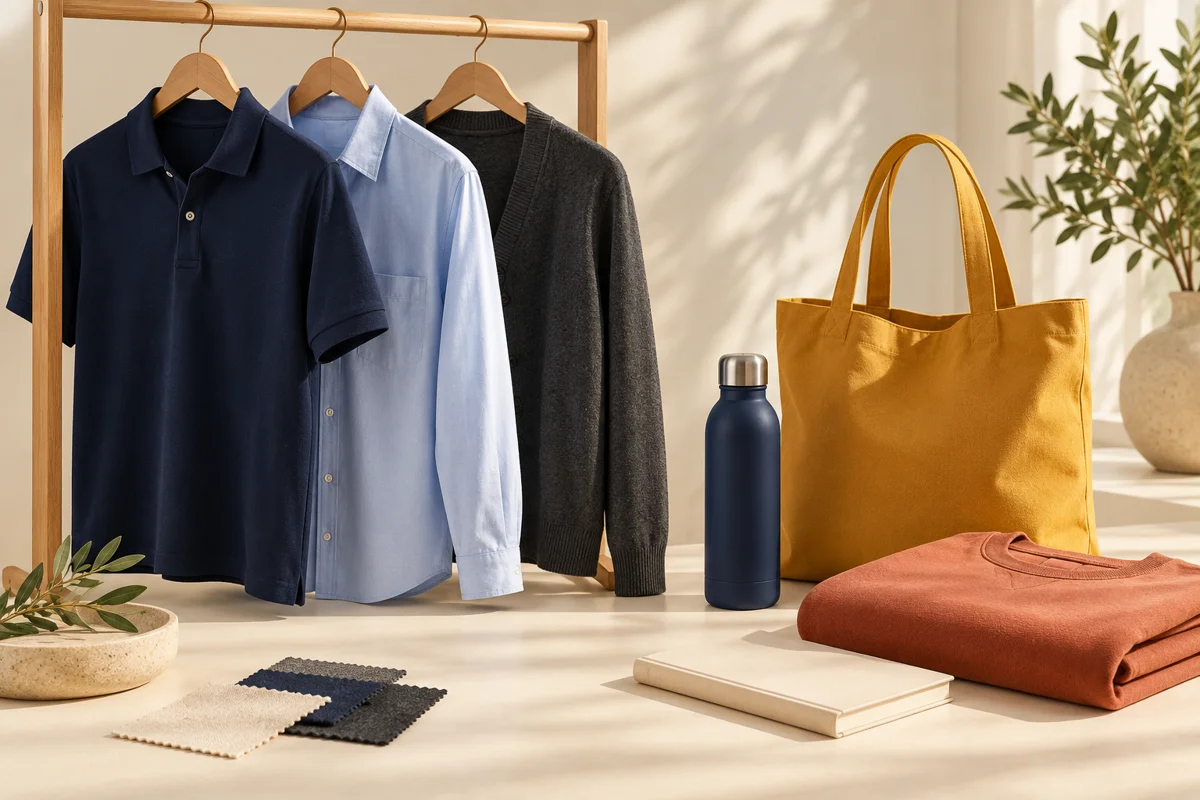
Publisher perspective: Brand Sauce publishes this comparison and sells company-store services. This is our buying framework, not an independent ranking or a claim that we are cheaper. Official provider pages were checked October 31, 2026. Public capabilities are separated below from requirements that still need confirmation. The hero is a conceptual illustration, not a photograph of either provider’s products.
First, compare the right Lands’ End service
Lands’ End’s services and capabilities page describes Standard as a self-managed storefront, Plus as a managed storefront with assortment and logo rules, and Premium as a managed option with additional presentation and support features. It also lists program certificates, allocation payments, payroll deductions and on-account billing for approved customers. Availability and terms need confirming for your proposed program.
That matters because a comparison against only its basic shopping experience would miss the managed alternatives. Ask which service tier the proposal covers. Do not compare the administration required by one provider’s entry option against the support promised in another provider’s customized proposal.
Lands’ End’s published program approach includes discovery, apparel planning, branded-store setup, bulk or individual ordering, fulfillment and ongoing support. In other words, “we want help running this” is not by itself a reason to rule it out. The next question is what the service will actually manage for your organization.
Where Brand Sauce belongs on the shortlist
Brand Sauce’s company-store overview and examples describe public or private storefronts, curated collections, approved decoration rules, gift cards, coupon codes, bulk orders and direct shipping. Our gift-card campaign page describes branded invitations, a chosen budget or collection, recipient selection and fulfillment.
Those are reasons to evaluate Brand Sauce for a recurring merchandise and recognition program. They are not evidence that every desired payroll connection, employee allowance rule, destination or product is supported automatically. Bring your actual requirements into the demonstration. A broad product range has little value if the six items your team needs cannot be ordered in the required sizes, quantities and countries.
Our editorial recommendation: shortlist Brand Sauce when you want the store experience organized around your brand and several gifting or merchandise use cases. Shortlist Lands’ End when its apparel assortment and uniform-program approach match the wardrobe you want. If both fit, let the acceptance test decide instead of treating either provider’s positioning as a score.
A comparison worksheet that avoids false yes/no answers
| Decision | Published starting point | Evidence to request from both |
|---|---|---|
| Who maintains the store? | Lands’ End separates self-managed and managed tiers; Brand Sauce presents a managed company-store service. | A named owner for product changes, logo changes and recipient support. |
| How is an employee funded? | Lands’ End lists several program payment methods; Brand Sauce describes gift cards and coupon codes. | A demonstration of your funding rule, including a failed order and refund. |
| Can one person order one item? | The answer depends on the product and decoration, not merely the existence of a store. | A one-unit cart for every approved SKU, with no hidden pooled purchase. |
| Does the wardrobe fit? | Lands’ End publishes apparel fit and size-range information; any program still needs exact item checks. | The required color, cut and size combinations, with a replacement path. |
| Can every destination participate? | Country reach does not establish local production, local returns or equal landed cost. | A destination-by-product matrix, delivery assumptions and return address. |
| Who owns unused stock? | Managed service does not, by itself, answer inventory ownership. | Written responsibility for reserved blanks, custom buys and leftover finished goods. |
Use three responses in the evaluation: demonstrated, confirmed in the proposal, and unresolved. Do not convert “not found on a public page” into “not available.” Equally, a salesperson’s general assurance should not count as a completed demonstration.
The crucial boundary: one-item apparel versus the whole assortment
Lands’ End’s customization page says there are no minimum quantities for custom embroidery or direct-to-garment printing on Lands’ End labeled products. The same page says other-brand promotional products require minimum quantities and offer bulk pricing. That is a meaningful distinction, not a minor footnote.
For a store built around a few approved shirts and layers, the first rule may fit perfectly. For a gift program combining apparel with drinkware and technology products, investigate each additional item. Do not extend the apparel minimum to every product pictured on the website. Likewise, require Brand Sauce to confirm the exact SKU, decoration method and destination rather than treating broad no-minimum messaging as a universal promise.
Build an orderability sheet with one row per product and columns for color, size, logo, minimum quantity, decoration charge, shipping destination and production lead time. Mark whether a single employee order triggers production, draws from stock you own, or waits for a group threshold. Our guide to what no minimum order really means explains why those models should not be mixed together.
Separate the wardrobe decision from the recognition decision
A required work wardrobe has a different success condition from a thank-you gift. The wardrobe must provide the approved appearance and usable fit when someone starts work. The recognition program should offer a worthwhile choice without making the recipient solve procurement problems.
Lands’ End’s assortment page describes multiple size ranges and fit options on selected styles. Treat that as a starting point for sampling, not proof that every preferred item is available in every combination. Ask for matched alternatives when a specific cut or size is missing. Do the same for a multi-brand assortment: matching color names do not establish a matched wardrobe.
A useful brief has two lists. The first is non-negotiable: approved role-specific clothing, acceptable decoration and a delivery requirement. The second is discretionary: a tote, a layer or another gift the employee genuinely wants. Combining those lists into one allowance can create an avoidable tradeoff if employees must spend their thank-you budget on required clothing.
You do not necessarily need two suppliers. You do need distinct rules. Ask each finalist to show how the employee sees those rules, what prevents the wrong purchase, and how the program owner reconciles the spending.
Compare inventory responsibility and total operating cost
On-demand ordering is attractive when recipient choices and timing are uncertain. Bulk buying can be sensible for a known group receiving the same item on a fixed date. A hybrid can hold a small approved stock of urgent starter garments while leaving optional gifts available individually. None of these arrangements is inherently the cheapest in every situation.
Lands’ End discusses inventory forecasting and volume pricing on its capabilities page. Ask what those services mean contractually for your order: who pays for committed stock, what happens when a style changes, and whether custom inventory must be bought out when a program ends. These are questions, not an assertion that a particular obligation applies.
For both proposals, compare the same quantity and delivery pattern. Include garments or gifts, decoration setup, application charges, store services, individual versus consolidated shipping, taxes or duties where applicable, exception handling and any committed stock. Pricing not expressly included in a current proposal is quote-needed. Do not build a savings claim from a temporary retail promotion or an old setup fee.
Illustrative workload calculation—not measured results: Suppose one proposed process leaves your coordinator with 18 exceptions a month, each taking 10 minutes. At an assumed internal labor value of $40 per hour, that is $120 a month, or $1,440 a year. This does not predict either provider’s workload. It gives you a way to value the manual steps observed during your own pilot. Keep that estimate separate from supplier invoices so a speculative time saving does not masquerade as a quoted discount.
Check country details before promising equal access
Lands’ End’s UK business notice says it no longer offers a UK-based business-to-business service, while UK organizations can order personalized clothing through its US business. It notes US-dollar transactions, possible customs and duties, and returns to the US. That is more useful than a vague “international shipping” checkmark.
For any provider, specify the destination, product, decoration, payer of import charges and return route. Ask whether the employee must advance money, arrange a cross-border return or accept a different product. Do not infer local fulfillment from a local currency display. A US-centered program may be entirely suitable for a US team; a mixed-country team needs a different evidence set.
Run a five-order acceptance test
Before moving a live employee population, ask each finalist to demonstrate these scenarios in an agreed test environment or through explicitly authorized sample orders. Keep screenshots, totals and the responsible support contact. Do not create unapproved production orders merely to test a checkout.
- The single replacement: One employee needs one approved shirt in a less-common size. Confirm the minimum, available color, decoration and delivery estimate.
- The funded gift: A recipient chooses within the assigned budget. Check whether shipping and decoration consume that budget and what appears when the total exceeds it.
- The unavailable item: A selected product cannot be supplied. Establish who contacts the employee, who approves the substitute and whether the original funding is restored.
- The second destination: Use another actual program country or, for a domestic program, a different permitted address type. Inspect the complete charges and support route.
- The administrative change: Remove an obsolete logo or product. Confirm that new orders cannot use it, while existing approved orders remain traceable.
Write pass criteria before seeing the demonstrations. A manual workaround may be acceptable for two exceptions per year and unacceptable for weekly hiring. Record its owner and cost instead of insisting that everything must be automated. The broader company-store pilot checklist can help turn these observations into a release decision.
The one-page decision card
- Primary job: required wardrobe, discretionary recognition, or both with separate rules.
- Approved assortment: exact products, sizes, colors and decoration—not a category list.
- Ordering model: individual, bulk or hybrid, with stock ownership documented.
- Funding: who pays, what the allowance covers, and what happens after a cancellation.
- Service scope: named owners for curation, changes, employee support and reconciliation.
- Geography: verified product-country combinations and return routes.
- Commercial decision: current comparable quotes plus unresolved requirements.
Stay with an existing provider if it meets these requirements and the proposed change offers no concrete improvement. If a change is justified, use a controlled provider migration rather than abandoning open orders, balances or approved artwork. A better storefront should reduce operational ambiguity, not merely look different.
Frequently asked questions
Is Lands’ End Business only a self-service apparel website?
No. Its current services page describes both self-managed and managed storefront tiers. Compare the specific proposed service, not just the public shopping site.
Can employees order one embroidered Lands’ End shirt?
The published no-minimum rule covers custom embroidery and direct-to-garment printing on Lands’ End labeled products. Confirm the exact item and configuration; other-brand merchandise has different minimum rules.
Does Brand Sauce automatically cost less?
No such conclusion follows from this comparison. Obtain equivalent quotes and include shipping, decoration, service scope, inventory commitments and the manual work your own test reveals.
Should uniforms and employee gifts use the same store?
They can, if the assortment and funding rules make the distinction clear. If required apparel competes with discretionary recognition funds or needs a different fulfillment model, separate the programs operationally even if they share a provider.