
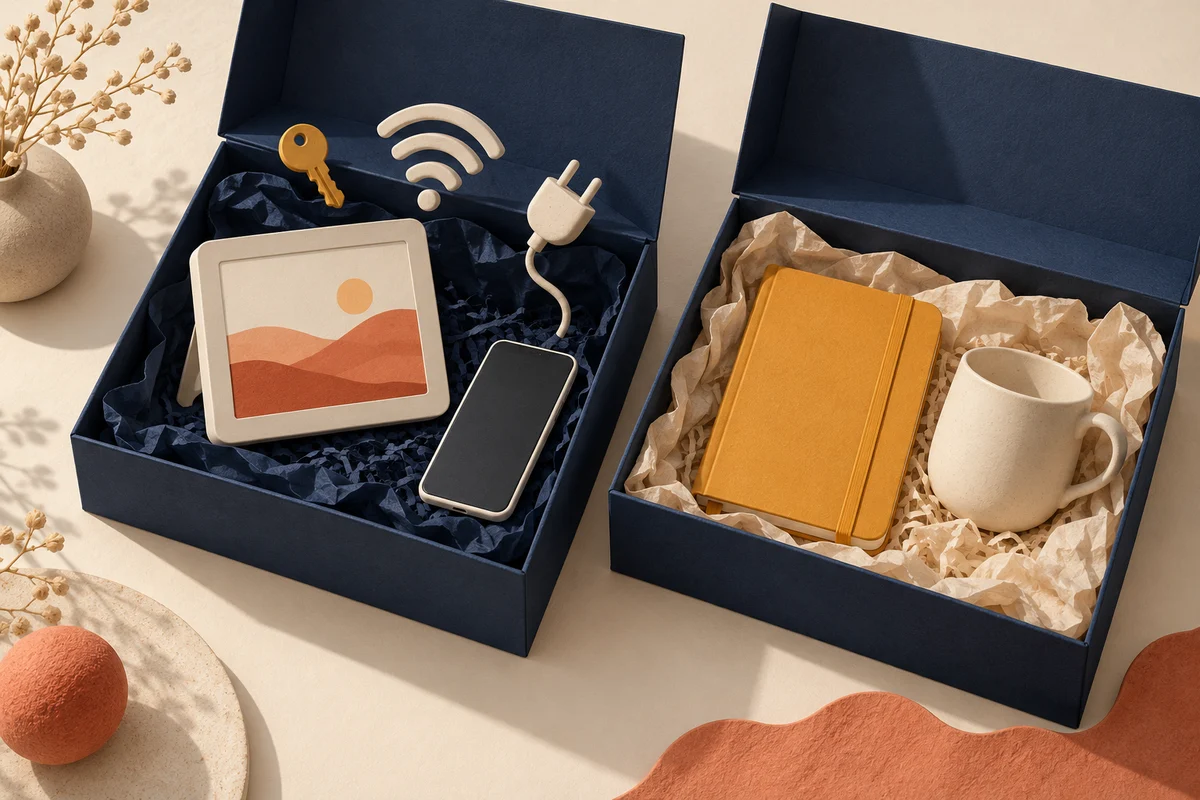
Offer app-connected employee gifts as an informed choice, not an automatic upgrade. Approve each option against three separate questions: what is required to start using it, what is required to keep using it, and what useful function remains if the recipient declines the app or account. Keep a comparable no-account choice in the same gift tier.
A premium gift can be a delight for someone who wants its connected features and a chore for someone who does not. Price does not resolve that mismatch. Neither does asking whether employees “like technology.” The useful decision is whether the specific setup and ongoing commitments fit the recipient's intended use.
Brand Sauce publishes this guide and provides company-store services. This is our recommended assortment and approval framework, not a claim that the example products are available through every Brand Sauce program. Manufacturer examples were checked October 23, 2026; exact models, decoration, destination-country availability and prices remain quote-needed.
Classify the dependency, not the product category
“Smart,” “wireless” and “app-enabled” are poor purchasing filters on their own. An app might add an optional adjustment, be needed once during setup, or be essential to the function that makes the gift worthwhile. Put every shortlisted model into a practical class before comparing prices.
| Dependency class | Approval question | Recommended assortment treatment |
|---|---|---|
| No account needed for the intended use | Can the recipient perform the promised task using the product's own controls? | Candidate for the low-setup route; still verify power, fit and care |
| App adds optional features | Is the no-app experience useful enough to justify the gift? | Describe both modes, with limitations visible before selection |
| App or helper needed for activation | Who completes the initial setup, and who handles a later reset? | Offer with explicit setup disclosure and an alternative |
| Ongoing network, account or service dependency | What stops working when that dependency is unavailable? | Offer only when the recipient wants that continuing relationship |
These classes are buying aids, not certifications. One device may occupy more than one class because different functions have different requirements. Record the promised task next to the classification. “Keeps a drink warm” and “lets the user adjust temperature from a phone” are two different promises.
For example, Ember's guidance distinguishes Mug² from Travel Mug². Mug² can maintain its default 135°F without the app; changing that setting requires pairing with the app, after which it remembers the selected temperature. Travel Mug² allows temperature changes on its own display. Do not transfer that description to a different generation simply because the brand name is unchanged.
By contrast, Aura's technical requirements specify an app and account for setup and ongoing internet-connected Wi-Fi and power for frame operation. Those requirements are part of the buying decision, not an incidental detail to reveal in a help email after delivery. They do not mean the product is a poor gift; they mean its appeal depends on a willing, workable setup.
Build one dependency card for every candidate
Use the following fields in the buyer's assortment sheet. The output should let a colleague understand the commitment without reading a marketing page or relying on the person who first shortlisted the item.
- Exact model and market: model number, generation, intended delivery country and the manufacturer support page checked.
- Promised use: the task the gift is supposed to perform, not every feature listed on its box.
- First-use requirements: compatible personal device, app, account, connection, power and any required accessory.
- Continuing requirements: network access, account access, charging, consumables and any paid service needed for the promised task.
- Fallback: what still works without the app, without internet or after a subscription ends; record these separately.
- Recovery: how the recipient handles a replacement phone, changed network, forgotten account access or transfer to another owner.
- Decision: approved for informed choice, approved as low-setup, awaiting evidence, or removed from this campaign.
“Unknown” is an acceptable research status, but not a shopper-facing promise. If a seller cannot substantiate an essential dependency, hold the item out of the launch. A statement that an app is free does not establish that every requested feature, storage service or future use is free. Verify those separately without inventing a fee where none has been documented.
Make low-setup a real choice, not a consolation prize
Build the tier around a comparable recognition experience rather than a hierarchy of technical complexity. A recipient who chooses a notebook, a conventional mug or another low-setup item should not be presented as declining the “good” gift. Conversely, do not strip connected options from the assortment simply because some recipients prefer less setup.
Ask a narrow optional preference question: “Would you like to see gifts that require an app or account, or would you prefer options without either?” This collects a useful selection preference without asking employees to disclose their phone model, home network or reasons. For campaign design, use the principles in our employee gift preference survey guide.
Keep dependency information beside the selection, before checkout. Suggested copy for a hypothetical product: “Requires a compatible smartphone and a personal account for initial setup. Internet is needed for the sharing feature. Prefer no account? Choose the alternative in this tier.” Replace every sentence with the actual model's verified requirements; this is a copy pattern, not a product specification.
Do not infer willingness from role, age or location. A technically skilled employee may not want another personal account. Someone who does not own a compatible device may still enjoy the gift with help they have freely arranged. The selection process should accommodate both without turning a preference into a workplace assessment.
Approve the recipient journey with a fresh sample
Test a sample as a new recipient would receive it, not as a demonstration unit already paired to the buyer's phone. Record observations separately from manufacturer documentation. A successful sample establishes what happened in that test; it does not prove compatibility with every device, network or country.
- Start unopened. Identify which charger, adapter, cable and instructions are actually included. Compare them with the supplier's quoted configuration.
- Attempt the promised no-app use. If the listing says an app is optional, verify the exact task that remains possible without installing it.
- Complete normal activation. Using a controlled test account and device, note account creation, permissions, updates and any paid-feature prompts. Do not use employee credentials.
- Test the documented fallback. Check the relevant disconnected or unpaired condition within the manufacturer's instructions. Do not claim indefinite offline operation from a brief test.
- Try a realistic recovery. Follow the official process for the relevant change, such as a new phone or network. Determine whether remote assistance is sufficient.
- Close the test. Remove the test account's access and follow the official reset or transfer procedure before any handoff. Record any unresolved limitation.
Stop approval if an essential task requires an unplanned payment, the advertised fallback fails, or the support handoff cannot be completed. A small inconvenience may be acceptable when disclosed. An undisclosed requirement that changes who can use the gift is an assortment decision, not something to bury in troubleshooting instructions.
Decide who supports the gift after delivery
Separate order support from device support. The store provider may handle missing shipments and order records, while the manufacturer handles pairing or account recovery. Do not describe that arrangement as “full support” unless the recipient can tell which contact handles which problem.
Also separate remote support from physical help. Aura's guidance for recipients without a smart device allows assistance from a friend or family member and some on-frame control after setup. It also says Wi-Fi configuration changes require someone on-site. A helpful remote support contact is not a substitute for that local step. The broader lesson is to verify the recovery route, not assume every connected gift can be fixed over email.
Our recommendation is that recipients control personal accounts and home-network setup. HR should not collect passwords, retain access to personal content or become the permanent device administrator because it purchased the gift. A helper should be chosen by the recipient, with a clear handoff. Required workplace equipment belongs in a separate IT-managed process.
Give recipients an order-support contact, the relevant official device-support link and whatever purchase evidence the agreed warranty process requires. Our branded gift warranty guide explains why product support and decoration support also need separate owners.
Compare total effort without inventing a failure rate
Quote the product and fulfillment costs, then budget for the work your program actually commits to: sample evaluation, requirement copy, support preparation and any arranged setup assistance. Keep employer costs separate from recipient-paid subscriptions or accessories. A cost shifted to the recipient has not disappeared.
Illustrative planning example, not measured results: suppose a team spends three hours evaluating a connected gift and preparing instructions. It then budgets twelve minutes of internal routing time for each of ten anticipated support contacts. That is five hours of internal effort: three hours plus two hours. At an assumed planning rate of $40 per hour, the labor allowance is $200, excluding purchase costs and manufacturer support time.
The assumed ten contacts are not a predicted failure rate. Replace that input with your own pilot observations or use several scenarios. Count routing work only once; do not charge the same support time to both the employer and provider unless they are genuinely doing different work.
On-demand fulfillment can avoid committing to unwanted selections, but it does not remove activation work. Bulk purchasing can suit a confirmed group that has chosen the same device and has an agreed handoff. A hybrid program can keep a limited connected assortment alongside simpler choices. Choose the production model after confirming demand and support responsibilities, not as a substitute for either.
Use a release decision, not a technology score
Approve a connected gift when the useful function is clear, the dependencies are verified, the recipient can choose knowingly and recovery has an owner. Offer it conditionally when it needs a willing helper or a specific personal setup. Hold it when an essential requirement remains unknown. Remove it from this campaign when no workable alternative or support arrangement exists.
For a hypothetical recognition program, this might mean keeping an app-optional mug as one choice, offering a network-dependent device only with clear requirements, and retaining a no-account alternative at the same recognition level. This is a planning illustration, not a tested assortment or a Brand Sauce availability claim.
Before launch, walk through the product copy, selection and help route together using our company-store pilot acceptance guide. After launch, record voluntary setup-help requests by issue type. Do not treat absence of a ticket as proof that a recipient activated or enjoyed a gift, and do not require personal device telemetry to demonstrate appreciation.
Frequently asked questions
Should employers avoid all gifts that need an app?
No. Connected features may be precisely what a recipient wants. Offer them with verified requirements, a useful alternative and a clear support handoff. Avoid making account creation an unexpected condition of receiving recognition.
Does “app optional” mean there is no setup burden?
No. Power, charging, accessories and local controls still matter. Ask which exact function works without the app and whether that function is sufficient for the promised gift experience.
Should a company pre-register everyone's device?
Not as a default for personal gifts. It can leave the employer controlling accounts or recovery. Prefer recipient-owned setup; any assisted route needs a deliberate transfer process and should not require employees to disclose personal passwords to the program team.
What is the simplest approval rule?
No essential unknowns, no hidden personal cost, no forced account as the only gift route, and no unsupported handoff. Those are recommended program rules, not claims that one technology or fulfillment model always wins.
Hero image is an AI-generated conceptual illustration, not a depiction of the named manufacturers' products.